Curious as to what might have motivated Leonard Zeskind to write a hatchet job on Noam Chomsky, I thought I’d look a little closer at his bio.
According to Zeskind, in addition to winning various awards and grants over the last 20 years or so for his journalism:
I am a life time member of the NAACP, [and] have in the past served on the board of directors of the Petra Foundation and the Kansas City Jewish Community Relations Bureau… I am president of the Institute for Research & Education on Human Rights, which examines racism, anti-Semitism and far-right social movements; analyzes their intersection with civil society and social policy; educates the public; and assists in the protection and extensions of human rights.
He is also, supposedly, a former member of the (now-defunct) Leninist ‘Sojourner Truth Organization’. According to one source, Zeskind was, along with Elaine Zeskind (his wife), responsible for establishing the STO in Kansas City in 1973. The STO itself was established in 1969 (or possibly 1970), and departed this world 16 years later, in 1985. Some of those formerly involved in the group (?) have established an online archive of STO publications (Insurgent Worker, Urgent Tasks: Journal of the Revolutionary Left, and various pamphlets); elsewhere, a fella called Michael Staudenmaier has a blog — The Sojourner Truth Organization: Notes Toward a History — with a view to publishing his research as a book. According to Mike:
I intend for my book to be a political intervention, aimed at anarchists and other revolutionaries, encouraging a rethinking of contemporary theory and strategy by drawing on the experiences and perspectives of a largely forgotten group of revolutionaries. I’m not interested in what one former member called “sociology” (by which I think he meant depoliticized, academic assessments), but rather in the lessons that can be learned by present-day and future radicals from this particular corner of hidden history.
One blog entry (May 26, 2006) explores ‘The Legacy for Anarchists’ of the STO. On a spotterly note, Mike writes that:
From beginning to end of STO’s existence, one of the group’s guiding principles was the notion that white people, including white workers and poor white folks, have certain privileges that give them advantages relative to any and all people of color. The idea of white skin privilege is now probably best known among anarchists through the journal Race Traitor, which not coincidentally was co-edited by Noel Ignatiev, who was a founding and long-time member of STO. Race Traitor was particularly popular with some segments of the membership of the Love and Rage Revolutionary Anarchist Federation, and again Ignatiev was briefly a member of L&R in the mid-90’s. A different version of the white skin privilege analysis has gained currency among those anarchists inspired by the writings of Chris Crass and in turn by the work of feminists of color like Elizabeth Betita Martinez.
Mike makes passing reference to Leonard, contrasting the approach adopted by those supportive of the concept of a ‘threewayfight’ to that being pursued by Zeskind. Thus:
It is worth noting that a different, more institutional and less confrontational version of anti-fascism draws on roots inside STO as well. The work done by Lenny Zeskind, a long-time member of STO, with the Center for Democratic Renewal in the nineties, contributed to the emergence of a variety of community-based, but definitely not anti-capitalist, anti-fascist coalitions in many parts of the US. The CDR, in turn, was originally founded as the National Anti-Klan Network, one of the initial left responses to the Greensboro Massacre; STO members were among the founders of the NAKN in late 1979.
In summary, Zeskind is a former (?) Leninist and member of the STO, responsible for establishing the groupuscule in Kansas City, and having written articles for its publications. In 1979, following the Greensboro massacre, he helped form the ‘Anti-Klan Network’; subsequently, the Network transformed itself (1980? 1985?) into the ‘Center for Democratic Renewal’ (CDR). The CDR closed its doors in
With regards the political and social milieu from which STO emerged, Mike further notes:
When STO came into existence, the New Left was reeling from the sudden collapse of SDS in 1969, and the founders of the group were drawn away from student organizing and toward workplace organizing as a venue for challenging white supremacy and building a revolutionary movement. From the start, members of STO took jobs in factories and attempted to make connections among the various forms of spontaneous resistance that were then common in a variety of industrial contexts. For the first several years of STO’s existence, this approach was the defining characteristic of the group, which was referred to in left circles in Chicago as “those people who organize in factories.”
Which fact gives me an opportunity for another spotterly digression, this time in the direction of the New York based zine Next Left Notes, which has a kick-arse family tree tracing the (mis-)fortunes of the various children of SDS. The STO’s ‘industrial turn’ also brings to mind similar efforts by members of what was then known as the Socialist Workers Party (now the Democratic Socialist Perspective) during roughly the same period (see : The Fourth International and the circle spirit).
And ah, a whole lotta other stuff, which I’ll elaborate on later — if I could be arsed.
In the meantime, SDS spawned a monster. Many monsters in fact. (Semi-)Contemporary descendants include:
Robert Fuller, “a 54-year-old Sydney Catholic priest has been arrested and charged after allegedly attempting to groom detectives who were masquerading as a 13-year-old girl, sending them a series of sexually explicit chat-room messages.” In response, “The Archbishop of Sydney, Cardinal George Pell said: “This is appalling and distressing news. I share the concern and alarm of parishioners, and particularly of parents and the school community. I can assure them that the safety of children in our parishes and schools is paramount, and the Archdiocese will co-operate fully with the police in relation to this and any other investigation into abuse at anytime.”
ROFLMAO!
NB. “Father Fuller used two names during the conversations – “rr” and “rogers_2468″ the document stated” : http://www.myspace.com/rogers_2468.
I feel sorry for the majority of Catholic priests whose ‘criminal acts’, such as they are, typically confine themselves to drinking (too much), smoking, gambling, and fucking (other adults).
“Dear young people, let me now ask you a question. What are you going to leave to the next generation? What legacy will you leave to young people yet to come? What difference will you make?” ~ Pope Benedict at WYD08, Sydney
Read also : ‘Starvation Army’, Skeleton Army, SCAM, [c.1999] : Twelve Reasons to Reject the Salvation Army. An expose of the Salvos and all their dirty laundry, revealing the far right links and insidious interests of this major ‘charity’ — essential reading for any one interested in the rights of the poor in Australia and anywhere else the Salvation spreads their dirty wings.
Trawling the web for texts on the history of ‘white nationalism’, I stumbledupon a new book by US writer Leonard Zeskind titled Blood and Politics: The History of the White Nationalist Movement from the Margins to the Mainstream (Farrar, Straus and Giroux, 2009). The subject is one in which I have a keen interest, so naturally when I obtain an over-priced copy in 10 years time at one of Melbourne’s better second-hand bookshops, I will read it. Until then, I will have to content myself with listening to the interview Leonard Lopate conducted with Zeskind on the subject of his book for WNYC in June 2009 (see above link).
As it happens, I’ve encountered Zeskind’s name before — he’s written quite extensively on the subject of white supremacy and the far right in the United States.
…anti-Americanism is a solid part of American life. But consideration of its ramifications is largely absent from the discourse inside the left… The questions must be asked: Are some opponents of U.S. imperialism also fundamentally anti-American? Do some anti-Americans serve as a core anti-imperialist opposition? The answer is “yes” on both counts.
I see: ‘anti-Americanism’ is as American as cherry pie (and ah, violence). To not be anti-American, then, is to be anti-American.
I think.
As for Chomsky, according to Zeskind, Uncle Noam:
…is representative of [a] trend on the left, a trend that mirrors conservatives on the right. Rather than finding the two-sidedness of American national life, they see only one aspect. The conservatives love their mono-dimensional country unconditionally and believe all others to be traitors. Those like Chomsky abjure their mono-dimensional enemy with unqualified contempt and believe all others to be morally bankrupt. It is a tendency rooted in the anti-imperialist movements of the 1960s and early 1970s, and the search for revolutionary agency.
Zeskind then goes on to describe this movement as it manifested in the United States, claiming that Chomsky “has emerged as the principal spokesperson for [this] older “anti-American” anti-imperialism”.
In essence, Chomsky embodies ‘anti-Americanism’.
According to Zeskind, he is also:
…an “anarchist,” we are informed, which he defines as a “libertarian socialist.” He is a free speech absolutist, we are reminded whenever a protest is lodged about his relationship to Holocaust denial and Robert Faurrison. And for twenty-five years [sic] he has been an indefatigable fighter against U.S. foreign policy, writing books faster than many people read the Sunday paper and giving speeches at every available venue. He has often skewered the hypocrisy of American elites, but at the same time he has demonstrated little understanding of the dynamics at work among the American people. For two decades, Chomsky has repeatedly sung one analytical note. Sometimes he hits the right target. Other times he has been remarkably tone deaf. One note. One idea.
America is Bad, mmmkay?
Among Chomsky’s many (other) crimes, Zeskind nominates: his delivery of a speech on the subject of US imperialism in May 1990 at the university in Hamburg — while at the same time ‘foreigners’ “were being burned out of their homes and attacked in every city”; his ridicule of the notion of ‘anti-Americanism’ and; his failure “to find a democratic or progressive thread within the American national narrative”, especially as it is to be found in the work of Eric Foner and “the industrial labor movements that culminated in the formation of the CIO in the 1930s”. In summary, according to Zeskind, Chomsky’s “frame of reference for democracy remains completely in the Third World”.
Finally, while noting that he is “not a neo-Nazi”, and does not deny the occurrence of the Holocaust, “Chomsky most certainly does not capitalize the H in Holocaust and give the event its proper name”, and fails (or failed) to note “any evidence of anti-Semitism… in Faurisson’s writings on the Holocaust”, describing him instead as ‘some sort of liberal’. In summary:
Simply put, on the issue of anti-Semitism, Chomsky is blind in both the left eye and the right eye. Two questions are then posed for left-wing intellectuals and anti-globalist street activists: Is it this man and this analysis that you want to follow when marching against war in Iraq or in opposition to free trade treaties? If irrational anti-Americanism becomes tinged with anti-Semitism, would Chomsky recognize it? Based on the evidence, the answer is an obvious no.
For my part, two questions are posed by Zeskind’s scribblings: Is this man serious? And: if he can read, why doesn’t he?
Oh yeah. As for the Dixie Chicks:
In response to Zeskind:
To begin with, the apparent fact that Chomsky gave a speech in Germany on US imperialism in May 1990, while assorted neo-Nazis were running around the country doing what neo-Nazis do best, is — like Zeskind’s other observations — just plain weird. The implication, clearly, is that Uncle Noam should have been drawing attention to these crimes, rather than those of the US state. Zeskind’s criticism of the (then) 62-year-old Jewish scholar was predicated on the fact that, rather than address this topic, Chomsky should have been denouncing neo-Nazism, or even been out there on the streets — along with Zeskind, of course — directly confronting those responsible for the attacks on ‘foreigners’.
Maybe Chomsky should have, but if so, I’m not aware of any complaints from German antifa that Chomsky failed to lead them into battle when they themselves took to the streets (see : George Katsiaficas, The Subversion of Politics: European Autonomous Social Movements and the Decolonization of Everyday Life, Second Edition, AK Press, 2006, esp. pp.165–168). Further, I’m unaware of his address having prevented any Germans from battling fascists — apart, of course, for the few hours (I assume) those who attended his speech spent listening to Chomsky.
Holocaust
Zeskind’s exceedingly bizarre assertion that Chomsky ‘refuses’ to capitalise the word ‘Holocaust’ is easily disproven by references to essays of his in which he does just that; but perhaps Zeskind is implying that Chomsky does not accord the Holocaust its proper place in history. In reality, in 1992, Chomsky stated the following (‘Israel, the Holocaust, and Anti-Semitism’, Excerpted from Chronicles of Dissent):
QUESTION: I ask you this question because I know that you have been plagued and hounded around the United States specifically on this issue of the Holocaust. It’s been said that Noam Chomsky is somehow agnostic on the issue of whether the Holocaust occurred or not.
CHOMSKY: I described the Holocaust years ago as the most fantastic outburst of insanity in human history, so much so that if we even agree to discuss the matter we demean ourselves. Those statements and numerous others like them are in print, but they’re basically irrelevant because you have to understand that this is part of a Stalinist-style technique to silence critics of the holy state and therefore the truth is entirely irrelevant, you just tell as many lies as you can and hope that some of the mud will stick. It’s a standard technique used by the Stalinist parties, by the Nazis and by these guys.
Democracy
On the question of Chomsky’s attitude towards ‘democracy’, Zeskind relies upon a single piece of evidence: the response Chomsky gave to a question put to him in an interview conducted in 1992 for Rolling Stone magazine. Here is the question and Chomsky’s answer:
QUESTION: Let’s start with the title of your latest book, Deterring Democracy. What do you mean by ‘democracy,’ what do our rulers mean by ‘democracy,’ and why are they deterring what you mean by ‘democracy’?
CHOMSKY: Well, like most terms of political discourse, democracy has two quite different meanings. There’s the dictionary meaning, and then there’s the meaning that is used for purposes of power and profit. According to the dictionary, you can say a system is democratic to the extent that citizens have ways to participate in some meaningful fashion in decisions about public affairs. That’s not a yes or a no matter. You have a lot of different dimensions in different societies. In the ideological sense of democracy — the Orwellian sense, in which the word is actually used — a society is democratic if it’s run by business sectors that are subordinated to the business sectors that run the United States. If it has that property, it’s a democracy. If it doesn’t, then it’s not.
So, for example, Guatemala in the early Fifties was a capitalist democracy in the dictionary sense of the word. In fact, it was one of the most democratic governments in the Third World anywhere. It had lots of popular support, there’s no doubt about that. Read the CIA analyses. One of the things they were worried about was that the government had so much support. But Guatemala was following policies of which the United States did not approve: independent nationalism, domestic development, land reform and so on. This was harming the interests of the elements that the United States regards as the natural rulers — they being the business classes that are linked to U.S. corporations and the military, insofar as they follow U.S. orders. Therefore the United States had to overthrow that government in 1954 to safeguard what we call democracy.
Or Nicaragua in the Eighties, to take a more recent case. An election occurred there in 1984, in fact, but not according to U.S. ideology. In newspapers, in journals of opinion, there wasn’t an election. The first election was in 1990. In historical reality, there was one in 1984. There has probably never been an election in history so closely investigated. The Latin American Studies Association, the professional association of Latin American scholars, did its first detailed analysis of any Latin American election. The Dutch government, which is very reactionary and pro-American, sent a delegation. The Irish parliament sent a delegation. Masses of observers. And the general conclusion, even by the most reactionary of them, was that this was a pretty effective election.
Of course, contra Zeskind, this is not the only occasion upon which Chomsky has had reason to refer to ‘democracy’, either according to a standard definition or that employed by apologists for US imperialism. For example: in 1977, Chomsky spoke of the ‘crisis of democracy’ detected by US elites and investigated on their behalf by the Trilateral Commission; in May 2002, he stated:
The Commission was a mostly liberal internationalist elite, from Europe, the United States, and Japan. It was mostly people like the Carter administration, liberal in the American sense of social democrats and internationalists. What they were deeply concerned about was an increase in democracy, that is, through the 1960s parts of the public that had usually been apathetic and passive began to get organized and to enter the political arena and press their demands and so on. That included women, working people, minorities, the elderly —in general the large part of the population that was usually passive. The way it’s supposed to work is that the political system is supposed to be in the hands of private tyrannies, private power, and that was beginning to erode. What they said is that there’s too much democracy and that’s no good, it’s a crisis, that we have to have more moderation in democracy, and we have to restore people to passive apathy.
In another interview (‘Radical Democracy’, Noam Chomsky interviewed by John Nichols, Capital Times, March 3, 1997), Chomsky refers to Shay’s Rebellion, the Whiskey Rebellion, and union struggles of the 1920s: “It’s a battle right through history. It’s not just the United States, of course. It was the same struggle in the English Revolution, which came before the revolution in the United States, and in every popular struggle since. And it’s going on right in front of our eyes today. It’s a never-ending struggle.” In ‘That Dangerous Radical Aristotle’ (Noam Chomsky, Excerpted from The Common Good, 1998), Chomsky says:
Aristotle [in Politics] took it for granted that a democracy should be fully participatory (with some notable exceptions, like women and slaves) and that it should aim for the common good. In order to achieve that, it has to ensure relative equality, “moderate and sufficient property” and “lasting prosperity” for everyone. In other words, Aristotle felt that if you have extremes of poor and rich, you can’t talk seriously about democracy. Any true democracy has to be what we call today a welfare state — actually, an extreme form of one, far beyond anything envisioned in this century.
In outlining his “anarchist” or “libertarian socialist” political views in yet another of umpteen interviews (‘Activism, Anarchism, and Power’, Noam Chomsky interviewed by Harry Kreisler, Conversations with History, March 22, 2002), Chomsky makes specific reference to American working class movements, arguing that in America:
…it has roots. Coming back to the United States, it has very strong roots in the American working class movements. So if you go back to, say, the 1850s, the beginnings of the Industrial Revolution, right around the area where I live, in Eastern Massachusetts, in the textile plants and so on, the people working on those plants were, in part, young women coming off the farm. They were called “factory girls,” the women from the farms who worked in the textile plants. Some of them were Irish, immigrants in Boston and that group of people. They had an extremely rich and interesting culture. They’re kind of like my uncle who never went past fourth grade — very educated, reading modern literature. They didn’t bother with European radicalism, that had no effect on them, but the general literary culture, they were very much a part of. And they developed their own conceptions of how the world ought to be organized.
They had their own newspapers. In fact, the period of the freest press in the United States was probably around the 1850s. In the 1850s, the scale of the popular press, meaning run by the factory girls in Lowell and so on, was on the scale of the commercial press or even greater. These were independent newspapers — a lot of interesting scholarship on them, if you can read them now. They [arose] spontaneously, without any background. [The writers had] never heard of Marx or Bakunin or anyone else; they developed the same ideas. From their point of view, what they called “wage slavery,” renting yourself to an owner, was not very different from the chattel slavery that they were fighting a civil war about. You have to recall that in the mid-nineteenth century, that was a common view in the United States — for example, the position of the Republican Party, Abraham Lincoln’s position. It’s not an odd view, that there isn’t much difference between selling yourself and renting yourself. So the idea of renting yourself, meaning working for wages, was degrading. It was an attack on your personal integrity. They despised the industrial system that was developing, that was destroying their culture, destroying their independence, their individuality, constraining them to be subordinate to masters.
There was a tradition of what was called Republicanism in the United States. We’re free people, you know, the first free people in the world. This was destroying and undermining that freedom. This was the core of the labor movement all over, and included in it was the assumption, just taken for granted, that “those who work in the mills should own them.” In fact, one of the their main slogans, I’ll just quote it, was they condemned what they called the “new spirit of the age: gain wealth, forgetting all but self.” That new spirit, that you should only be interested in gaining wealth and forgetting about your relations to other people, they regarded it as a violation of fundamental human nature, and a degrading idea.
That was a strong, rich American culture, which was crushed by violence. The United States has a very violent labor history, much more so than Europe. It was wiped out over a long period, with extreme violence. By the time it picked up again in the 1930s, that’s when I personally came into the tail end of it. After the Second World War it was crushed. By now, it’s forgotten. But it’s very real. I don’t really think it’s forgotten, I think it’s just below the surface in people’s consciousness.
And, of course, there are Chomsky’s voluminous writings. Most appropriate, perhaps, in the current context, is the essay Chomsky wrote 40 years ago on ‘Objectivity and Liberal Scholarship’:
If it is plausible that ideology will in general serve as a mask for self-interest, then it is a natural presumption that intellectuals, in interpreting history or formulating policy, will tend to adopt an elitist position, condemning popular movements and mass participation in decision-making, and emphasizing rather the necessity for supervision by those who possess the knowledge and understanding that is required (so they claim) to manage society and control social change. This is hardly a novel thought. One major element in the anarchist critique of Marxism a century ago was the prediction that, as Bakunin formulated it:
“According to the theory of Mr. Marx, the people not only must not destroy [the state] but must strengthen it and place it at the complete disposal of their benefactors, guardians, and teachers-the leaders of the Communist party, namely Mr. Marx and his friends, who will proceed to liberate humankind in their own Way. They will concentrate the reins of government in a strong hand, because the ignorant people require an exceedingly firm guardianship; they Will establish a single state bank, concentrating in its hands all commercial, industrial, agricultural and even scientific production, and then divide the masses into two armies-industrial and agricultural-under the direct command of the state engineers, who will constitute a new privileged scientific-political estate.”
One cannot fail to be struck by the parallel between this prediction and that of Daniel Bell – the prediction that in the new postindustrial society, not only the best talents, but eventually the entire complex of social prestige and social status, will be rooted in the intellectual and scientific communities Pursuing the parallel for a moment, it might be asked whether the left-wing critique of Leninist elitism can be applied, under very different conditions, to the liberal ideology of the intellectual elite that aspires to a dominant role in managing the Welfare state.
Zeskind, in avoiding any reference to these and many other examples of Chomsky’s views on ‘democracy’, has accomplished some feat. This avoidance, of course, being necessary to maintain the fiction that his “frame of reference for democracy remains completely in the Third World”. The grain of truth in this assertion lies in the fact that Chomsky does indeed comment upon and draw inspiration from popular movements in the ‘Third World’ (as do millions of his fellow Americans) and, further, in his contention that the peoples of the ‘Third World’ — rather than the US state, and the elites which frame its foreign policy — are those who should determine their own fate. Hence, the application of the term ‘anti-American’, and — given the consistency with which he has advocated this rather straightforward, ethical and political proposition — Zeskind’s complaint that Chomsky is “tone deaf”.
Finally, inre Zeskind’s warning to “left-wing intellectuals and anti-globalist street activists” of the perils of allowing this irrational bigot to assume some kinda leadership role within ‘progressive’ social movements — “Is it this man and this analysis that you want to follow when marching against war in Iraq or in opposition to free trade treaties?” — the question, like Zeskind’s critique as a whole, rests on very shaky premises. Marching against war in Iraq — or even taking direct action against the military-industrial-entertainment complex — is more likely to be(/have been) inspired by revulsion at criminal mass murder than it is Chomsky’s alleged ‘anti-Americanism’. By the same taken, ‘opposition to free-trade treaties’ — or even to capitalism as a whole — proceeds from an understanding of its effects upon those subjected to its provisions.
WOMAN: But the critique of the media in the film is taken from speeches that you gave.
CHOMSKY: Yeah, but that’s because other people are doing important things and I’m not doing important things — that’s what it literally comes down to. I mean, years ago I used to be involved in organizing too — I’d go to meetings, get involved in resistance, go to jail, all of that stuff — and I was just no good at it at all; some of these people here can tell you. So sort of a division of labor developed: I decided to do what I’m doing now, and other people kept doing the other things. Friends of mine who were basically the same as me — went to the same colleges and graduate schools, won the same prizes, teach at M.I.T. and so on — just went a different way. They spend their time organizing, which is much more important work — so they’re not in a film. That’s what the difference is. I mean, I do something basically less important — it is, in fact. It’s adding something, and I can do it, so I do it — I don’t have any false modesty about it. And it’s helpful. But it’s helpful to people who are doing the real work. And every popular movement I know of in history has been like that.
In fact, it’s extremely important for people with power not to let anybody understand this, to make them think there are big leaders around who somehow get things going, and then what everybody else has to do is follow them. That’s one of the ways of demeaning people, and degrading them and making them passive. I don’t know how to overcome this exactly, but it’s really something people ought to work on.
Despite noting the fact that Chomsky has written many scores of books, hundreds of essays, and given thousands of interviews and speeches, Zeskind relies on exactly two texts to support his arguments, neither of which are long or especially comprehensive: ‘Anarchy in the U.S.A.’, Noam Chomsky interviewed by Charles M. Young, Rolling Stone, May 28, 1992 and ‘Is Chomsky ‘anti-American’?’, Noam Chomsky interviewed by Jacklyn Martin, The Herald, December 9, 2002.
PS. Unity News announced on August 5 that it would be closing, “to allow the administrators to concentrate on the Norfolk Unity website, which will carry all the news that would have appeared here.”
Damn.
I gotta shitload of sites bookmarked.
Now I gotta tell ’em: it’s over girlfriend.
*snap*
Bloggy
Soundtrack for this post:
[Clenched fist salute to Carlos.]
The death of Grods has brought new life to the blogosphere, and A Fresh Start in August. I’d tell Bron to cheer up but the definition of a pessimist is someone who hasn’t yet heard the bad news. Instead, I’ll simply refer to the title of Dorothy Gallagher’s biography of Carlo Tresca: All the Right Enemies.
Often described as a “freelance revolutionary,” Carlo Tresca (1879-1943) was one of the most compelling and colorful figures of the American left prior to World War II. A newspaper editor, labor organizer, civil libertarian, anarchist, anti-Fascist and anti-Stalinist, Tresca had absorbed his fiery socialist principles and had been active as a trade-unionist and editor in his native Abruzzi before immigrating to the United States in 1904.
After joining the International Workers of the World (IWW) in 1912, Tresca was involved in a number of strikes, including the Lawrence, Massachusetts textile strike (1912), the New York City hotel workers’ strike (1913), the Paterson silk strike (1913), and the Mesabi Range, Minnesota, miners’ strike (1916). He edited a newspaper called L’Avvenire (The Future), first in Pennsylvania and, from 1913, in New York City. Its successor, from 1917, was Il Martello (The Hammer). Tresca’s uncompromising anarcho-syndicalist views resulted in frequent clashes with local and federal authorities, and repeated confiscation of his publications.
He devoted considerable energy to campaigning on behalf of Sacco and Vanzetti in the 1920s and also became preoccupied with the struggle against fascism. Pursued by the U. S. government at the behest of the Mussolini regime, he survived several assassination attempts by fascist supporters. The Spanish Civil War intensified his anti-Communist activity and propaganda, earning him more enemies on the American left.
On the evening of January 11, 1943, Tresca was shot to death on the sidewalk in front of his office at Fifth Avenue and 15th Street. Over the years there has been a lively debate about which of Tresca’s many enemies might have been behind the murder. His murder was never prosecuted.
YouCoont is a new blog what Wah — a former Grods commentator — done. In brief, in various posts, references of a defamatory nature to TV personalities and other VIPs are made. Word on the virtual street is that concerned parties have obtained legal advice confirming the status of the material as being offensive and defamatory. They seek to have the articles/blog removed immediately from teh Intertubes. Should Wah not remove the offending material, they are instructed to brief solicitors on behalf of their client(s) to seek an injunction and damages.
I have nominated Dylan Lewis as a coont, not because he’s annoying — which is something HE MOST DEFINITELY IS NOT — but rather because he makes the vast swathes of humanity who are not as superbly talented as he is feel bad. (And sad.)
Poumista, as ever, offers a truly superb neat-o experience dining on radical history… although Poumista’s blogroll suffers from one, rather obvious, lapse.
Fires never extinguished is a blog of the fearsomely-titled Phoenix Class War Council. It is… good.
Vengeance is another angry blog comin’ outta The Belly of the Beast otherwise known as the United States, which seeks its title in the realms of the class war. Notes on a New Proletarian Anarchism is especially interesting, and the author of the blog has won the love and affection of the spelling Nazi inside of me, and will no doubt appeal to the spelling Nazi inside you too.
…not Aotearoa Skinhead. Which is like, all about skinhead and The Spirit of ’69!
Pick-up lines is a Maoist-Third Worldist project. Our goal is to provide a map of the so-called “left” for those who are not familiar with the distinctions between various lines and organizations. Our goal is to provide as many capsule reviews of online “leftist” websites as possible. Thus making it easier for people to distinguish the genuine revolutionaries from the fakes. Plus, we’ll have some fun looking at, and occasionally poking fun at, all the nonsense that passes as “revolutionary.” The title of the blog is, of course, a joke since most of ideological lines of the so-called “Left” are so unscientific that they might as well be, and often are, “pick-up lines.”
ZAPAGRINGO is a blog by RJ Maccani, who sounds like a righteous d00d. His (?) blog documents the continuing relevance and global effects of the Zapatista uprising of 1994, a revolt by some of the poorest, most oppressed sectors of Mexican society, whose struggles continue and whose determination continues to inspire creative resistance everywhere.
Dreaming Neon Black is authored by a dirty! rotten! lousy! stinking! communist. Workers are constantly fighting back on his blog, and so I would encourage Adam to post as often as possible, as quite frankly, I’m getting a little impatient for the social revolution.
So… that’s a bakers’ dozen of blogginess.
And I still got several hundred more bookmarks to wade through.
*sigh*
Anyway, here’s a song for all the lawyers and all the cops out there. Where would we be without them?
All:
God save your majesty!
Cade:
I thank you, good people—there shall be no money; all shall eat
and drink on my score, and I will apparel them all in one livery,
that they may agree like brothers, and worship me their lord.
Dick:
The first thing we do, let’s kill all the lawyers.
Hammerskins in Spain are in heap ’em big trouble with Spanish authorities. In fact, late last month the organisation was declared unlawful by a Madrid court, and 15 of its members sent to jail — the culmination of an investigation begun in 2003 (‘Condenados por asociación ilícita 15 integrantes de un grupo neonazi’, Anaís Berdié, El País, July 25, 2009). The bonehead’s leader, Jose Eduardo Chapela, was sentenced to two-and-a-half years imprisonment, while the other boneheads have been sentenced to 18 months (with the exception of Angel Martinez, who received an additional one-year sentence after being found guilty of possession of an illegal weapon).
The outlawing of the Spanish franchise of the US-based neo-Nazi skinhead/bonehead network follows similar declarations by state authorities regarding their kissin’ cousins in ‘Blood & Honour’ (B&H) in Germany, Portugal (2005) and Belgium. The Spanish state’s declaration is significant as it is the first time that membership of a neo-Nazi organisation has been declared illegal — that is, with the possible exception of the local B&H franchise.
In Australia, the local Hammerskins franchise — known as the ‘Southern Cross Hammerskins’ (SCHS) — was established in 1993 by Melbourne bonehead Scott McGuinness, the vocalist in now-defunct band Fortress (Fortress played what was supposedly their final gig in 2007 at the Melbourne Croatia Social Club in Sunshine). Scott is also widely blamed for introducing ‘Blood & Honour’ (B&H) to Australia in the same year (1993). B&H and the SCHS are jointly organising the ‘Ian Stuart Donaldson’ memorial gig on September 12 this year in Melbourne, an annual event held each year since the Skrewydriver’s death in 1993.
The last gig organised by B&H and the SCHS was scheduled to take place on April 25 in Perth. Word on the street is that former Skrewdriver and current Quick & the Dead band member Murray Holmes is being blamed for its (apparent) failure. As far as B&H/the SCHS are concerned, however, the gig has disappeared down the memory hole, so who knows?
Note that the Hammerskins, especially in their heartland in the United States, have a long history of engaging in racist violence. As well as being perpetrators, they have also been victims (and not only as a result of internecine squabbling). Thus:
Joe Rowan (Nordic Thunder)
In keeping with the aim of “forging a new destiny for white power music”, Resistance Records held a tribute to Ian Stuart; a memorial gig held on September 30, 1994 commemorating the second [sic] anniversary of Ian Stuart’s honourable death in a car accident. “The Flame That Never Dies” concert was organised professionally at a large venue in Racine, Milwaukee featuring No Remorse from Britain, Bound For Glory, RAHOWA, Centurion, Berserkr and Das Reich. Less than 300 showed up to this event, billed convincingly enough as “The Concert Event Of The Decade”. Immediately after the concert, Joe Rowan, the vocalist for Nordic Thunder decided to commemorate Ian Stuart’s passing in his own special way. Following an altercation in a convenience store, a black man dispatched Rowan to Valhalla with a handgun blast to the head. A video release of the concert is set for release sometime this year, so hopefully it will include some stunning post-concert footage!
Eric Banks (Bound for Glory)
In a bid to reach out to a broader ‘white’ market in North America, Resistance Records have made it a priority to organise and appeal to the metal scene. At the tail end of 1994, Resistance Records had signed four ‘White Power metal’ bands, Centurion (Milwaukee), New Minority (formerly Ritual, New Jersey), Berserkr (Oklahoma), and Bound For Glory (Minneapolis). Bound For Glory, a Northern Hammerskin band who formed in 1989, are quite popular on the world-wide scene and even featured in the American Pit Magazine, which caters to the metal audience. BFG’s original singer, Eric Banks, was put down for a dirtnap via shotgun blast by a SHARP skin in Oregon early on in 1994.
…Let’s start at the beginning, right after Mulugeta Seraw’s death in 1988.
The first rally to protest the death of Seraw was called by African students in Portland a few days later, in spite of opposition by the police and neo-liberal politicians (and some progressive groups).
When hundreds of people showed up, the governor of Oregon, Neil Goldschmidt, asked to speak. The rally organizers, who did not even know who he was, allowed him to talk. So began a continuing effort to coopt the grass-roots movement against neo-fascists, while attacking those who carried out militant actions.
The Coalition for Human Dignity initially met in the same chambers used by the Portland City Council. The community activists and college kids who composed its members spent much of 1989 vacillating between calling rallies, attempting to get city and union resolutions passed and taking direct action.
The decision was finally made to attack the boneheads where they lived, worked and played. While the Oregonian and neo-liberal politicians made speeches against “hate”, the remaining members of CHD, along with the new groups Anti-Racist Action and Skinheads Against Racial Prejudice decided to destroy the fascist groups in town. This meant that they were to be confronted when they appeared publicly but, more importantly, they would be attacked in ways that they were not prepared for.
ARA, SHARP and members of the punk music community, including members of CHD, began to drive the boneheads out of the clubs and the culture. Bands that had huge local followings, such as Poison Idea or Sweaty Nipples, stopped concerts to speak against boneheads and vowed not to play if they congregated at their shows. Some bands changed their names, such as Wehrmacht or took on confrontational anti-racist names, such as Crackerbash.
Security at most of the clubs began refusing to let open boneheads into the clubs – which led to tense scenes such as the 1991 Fugazi show at Pine Street Theater when a hundred boneheads, male and female, showed up and threatened to burn it down if they were not let in. They didn’t get in…
So, before being rudely interrupted by the “strategic, proactive and well connected talent management company that successfully creates and maximizes opportunities for its clients with major media partners” — akaProfile Talent Management — I was gonna write a review of a film Dr. Cam and I saw last week as part of the Melbourne International Film Festival (MIFF). The film is titled
and had its Australian premiere at the Festival. (See also : Still Looking for Eric, July 19, 2009.)
I didn’t take notes or nothin’, so am relying on memory.
“The immediate object of the League is to stop, by appeals to reason and conscience and, if necessary, by appeals to law, the defamation of the Jewish people. Its ultimate purpose is to secure justice and fair treatment to all citizens alike and to put an end forever to unjust and unfair discrimination against and ridicule of any sect or body of citizens.” ~ ADL Charter October 1913
In Defamation, director Yoav Shamir’s quest is to understand ‘the new antisemitism’, and in particular the role of the Anti-Defamation League (ADL) in combating its spread. The ADL is not. happy. Yoav. with their depiction in the film, which is largely unflattering: attention is drawn to the fact that, while the ADL has an enormous budget (US$70 million in 2008), the instances of anti-Semitism documented in the film as being of concern to it are relatively trivial — the most serious incident being when some stones were thrown at a skool bus containing (sleeping) Jewish children.
Eclipsing efforts to fight such actions — and the circumstances which give rise to them — the film concentrates, though certainly not exclusively, on examining the relationship between the ADL and the Israeli state, and the role the ADL plays as an apologist for Israeli government policy.
As for the ADL, further indication of its current role is given by the fact that, as the ADL put it: “When the 9/11 terrorist tragedy struck our nation, ADL’s motto became: ‘9/11, the day hate became everyone’s problem'”. In the context of The War On Terror™ — which the ADL appears to generally support — and its conduct of a propaganda campaign in support of the Israeli state’s most recent military assault upon Gaza (see : Chomsky on Gaza, January 19, 2009), such questions become especially urgent.
When Israel fought back against Hamas rockets in December 2008, ADL immediately mounted a comprehensive campaign making Israel’s right to self-defense concrete and personal. The goal was to ensure, through a variety of classic and innovative ADL approaches, that a broad audience grasped the danger and terror experienced by increasing numbers of Israelis on a day-to-day basis. ADL experts continuously updated special Web pages providing extensive information and analysis about the conflict. We advocated. We communicated through ads and op-ed pieces. We monitored reaction and issued reports. We alerted and aided campus officials. We took polls, issued statements and wrote to world leaders. In so many ways, ADL’s voice — and message — was heard.
In general, the film provides some insight into the ADL’s role in contemporary politics — whether in terms of US domestic, Middle East or European — as well as the ways in which the Shoah, and the existence of the Jewish state of Israel, informs contemporary understandings of anti-Semitism. The extent to which the figure of The Muslim (Terrorist) has supplanted that of The (Avaricious) Jew as the hate figure of choice in the minds of various, predominantly Western, publics, is also noted (though briefly).
Shamir probes the ADL in a number of ways, including by way of accompanying ADL Chairman Abraham Foxman to Poland, and to Auschwitz — the Nazi death camp Foxman survived as a child. Shamir also follows a group of Israeli high skool students to the camp. (Their teenage antics on the way to and within Poland cause their minders — Israeli secret squirrels — some (frequently amusing) headaches.) The Israeli kids’ visit forms part of a more general effort to educate them about the war, and in particular the Nazi genocide. Notably, as part of their preparation, the students are informed that Jews are still hated in Poland, and that locals cannot be trusted not to attack them. Some of the students do, however, speak to some elderly Poles, and the old men’s query (‘Are you from China?’) is lost in translation, the students leaving the conversation thinking that they have been racially villified, and the elderly Poles none the wiser.
Incidentally, this scene reminded me of a documentary I saw some years ago examining Jewish life in contemporary Poland. At one point, participants in a Jewish cultural event learn that there may be a neo-Nazi mob on its way intent on disrupting their activities: it is only when the mob turns the corner that it is revealed that they are in fact Polish antifa/classwarhooligans, come to offer support and, presumably, in the expectation that by doing so they might have an opportunity to confront the (neo-)Nazi scum. (See also : Poland: Solidarity for Tomek Wilkoszewski, July 26, 2006 | http://tomek.most.org.pl.)
The ADL itself is generally hostile to anarchism, anarchists, and anarchist participation in anti-racist and anti-fascist activism, especially in its more militant forms. (At one point, the ADL classified the circle ‘A’ as a hate symbol.) This reflects its statist, and otherwise politically conservative — which is to say, classically bourgeois — perspective. In essence, the ADL maintains that the police/state can and should protect the rights of Jews in the United States (and elsewhere), the Israeli state is the ultimate guarantor of Jewish survival, and the fight against anti-Semitism should properly be conducted within the legal and political constraints of bourgeois society.
This approach can, of course, be understood, not only by reference to the genocidal campaigns conducted by the Nazis (and those of other fascist regimes of the era — see : Ljenko “Little Goebbels” Urbancic) but by way of recognising the status of anti-Semitism as ‘the oldest of hatreds’.
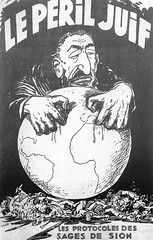
Russia — to which Shamir travels to briefly interviews some Jews in St. Petersburg — was once awash with anti-Semitism, and hatred of Jews cynically employed by the Tsarist regime to sap popular anger and direct it in a harmless (to elites) direction. Notably, the country gave birth both to the Tsarist forgery The Protocols of the Elders of Zion — available for download from Australian Protectionist Party member Martin Fletcher’s website, along with a wealth of other anti-Semitic and otherwise racist materials — as well as the Anarchist Black Cross.
The rulers of [Russia] had in effect declared a civil war against their own subjects. In particular they used the Cossacks to murder the Jews. The Jewish population was a hostage to the revolution. If the Russian workers protested, the Czar diverted their revolutionary aims by organising a pogrom. It was at once an example to the Russian masses, and a warning as to what would happen to those who incurred official displeasure. When the “Black Hundreds” raided the Jewish districts, the police stood by. If ever the Jews resisted (and Anarchists and Bundists at times organised Self Defence Committees that fought back) the police stepped in and fought the defenders, arresting them for violent activity.
International Jewry organised its own committees for relief of the Russian Jews; but such bodies did not extend their help to the Anarchists and Bundists who had — dreadful to relate to the bourgeois sponsors of such committees — had the temerity to fight back. So a committee was formed in America, amongst Russian Jewish workers in particular, called the WORKERS RED CROSS (which changed its title after a few months to ANARCHIST RED CROSS, since the Red Cross Workers, asked them to do so to avoid confusion).
On the whole, apart from a few technical flaws (especially the poor audio during a number of scenes involving hushed conversations), and the presentation of a somewhat incomplete picture of contemporary manifestations of anti-Semitism in the US in particular (see, for example, James von Brunn), Defamation is very worthwhile viewing, especially given that no film could cover such a broad topic in a comprehensive fashion.
As for Australia, in a month or so (September 12), neo-Nazi skinheads will be gathering in Melbourne, as they have every year for the last 15, to celebrate their rank bigotry and to commemorate the death in 1993 of Ian Stuart Donaldson, the principal instigator of the contemporary neo-Nazi music industry. Other anti-Semites will be gathering at the Sydney Forum two weeks later (September 26/27), where the MC will be the German-born Holocaust denialist — and close comrade of the Adelaide-based denialist Fred Töben — Welf Herfurth (see : Terrie-Anne Verney : Take the Money And Run, August 11, 2009).
With regards the Melbourne gig, its occurrence has met with general indifference on the part of those who might otherwise be expected to organise to oppose and to sabotage its conduct — a product, in part, of the relative obscurity and generally marginal status of boneheads in Australia, but also, on the one hand, a symptom of the yuppification of punk and other yoof subcultures, and, on the other, the near-total absence of a broader, radical left-wing movement. My own role in helping to expose such activities has resulted in death threats, threats of beatings, the publication of my alleged work address on an Internet forum frequented by boneheads, and other tomfoolery. Nevertheless, those responsible will always be held to account — one way, or another.
Anarchists took to visiting clubs, restaurants and boarding houses known to be frequented by Fascists, and provoked the latter to fight. The anarchists were armed with knives, truncheons and even pistols. Uncorroborated evidence indicates that during the 1928 Victorian timber strike they were considering the use of explosives, in support of the strikers. Yet, the most common form of violence during these years was the practice of assaulting members of Fascist organisations and of ripping from their coats the Fascist Party badge, that the anarchists publicly and contemptuously named the nit. Even Fascist Consuls were not exempt from this treatment. Count Gabrio di San Marzano, Italian Consul at Brisbane, while attending a reception given in his honour at Ingham had his badge stripped from his official dress and, adding insult to injury, the triumphant anarchists also encouraged the band to play the Internationale. This same Consul was repeatedly beaten and spat upon during his visits at Ingham, Babinda and Cairns, and was eventually and humiliatingly driven to accept police protection when he went to Innisfail.
This philosophy of direct action, incessantly preached and practised by Italian anarchists, starkly differentiated them from the other Italian political groups who, like the Communists, devoted themselves to organisation or who, like the more respectable Socialists of the Concentrazione Antifascista dell’Oceania, concentrated their effort on commemorations of past victories and defeats. Indeed, it was this recourse to action which made the anarchists so popular and attracted to them such a large following. As Carmagnola said in 1930, ‘we must remember our martyrs not only with speeches and flowers, but with guns, not like slaves, but like men. We must not celebrate, but avenge. A people that does not fight violence by means of violence, that bends its knees and cowardly tolerates the impositions of infamous mercenaries, is unworthy of such a name’…
The political decline of Anarchism in the ‘thirties was considered by many of its followers as a mere temporary setback in the long march towards the form of society that they dreamed of accomplishing. During those dark years of Fascist triumphs they believed stubbornly in the defiant words which end Malatesta’s pamphlet Anarchy [?] and which, in the final analysis, prove to be historically relevant when applied to the anti-Fascist activities of Italian anarchists in Australia:
Whatever happens, we shall have some influence on events, by our numbers, our energy, our intelligence and our steadfastness. Also, even if now we are conquered, our work will not have been in vain; … If today we fall without lowering our colours, our cause is certain of victory tomorrow.
In July, a racist dingbat named Terrie-Anne Verney was sacked from her job as a sales rep for Griffith FM community radio station 2MIA. Terrie-Anne’s dismissal followed hot on the heels of her exposure as a racist (Multicultural radio presenter linked to anti-immigration Facebook groups, Asher Moses, The Age, July 2, 2009). In solidarity, Darrin — the face of the ‘Australian Protectionist Party’ (APP) — organised to raise a sum of money to donate to Terrie-Anne. Over a two-week period, over $400 was raised (or at least that’s what Darrin wrote on the Facebook page for the group ‘Fuck Off, We’re Full’) which sum Darrin dutifully transferred to Terrie-Anne.
A grateful Terrie-Anne tearfully wrote the following in appreciation (July 20, 2009 at 11:26pm):
The amount of support I have recieded [sic] in the last 2 weeks has amazed me.
The money that was raised on my behalf by Darrin Hodges has been appreciated and I thank everyone who parted with some of their hard earned cash to help a fellow Australian. I have been amazed by the generousity [sic] of my fellow Australians. The strength, support, kindess [sic] and friendship extended to me over the past fortnight has been overwhelming.
I thank each and every one of you have [sic] offered me your support and thrown whatever you could afford into the account, and thankyou to Darrin for putting it all together and offering me whatever assistance he could.
It is good to know that in times of need, that we can still rally around and offer suport [sic], strength and help to some body who needs it.
Perhaps the Aussie Spirit is alive and well after all.
Sadly for Darrin, a week later it was announced that ‘Terrible’ Terrie-Anne would be addressing the 2009 Sydney Forum (September 26–27), an annual event organised by Darrin’s arch-rival Dr James Saleam:
Terrie-Anne Verney
Being persecuted and fired from your workplace due to the personal political opinions you hold only happens in totalitarian regimes overseas, it would never happen in Australia in 2009… or would it? Hear a strong and brave young woman talk about how this happened to her in liberal democratic Australia because of her views on multi-culturalism and immigration.
A strong and brave young woman whose presence at the Forum was aided by one of its principal (‘white nationalist’) critics! (On the ding-dong battle between ‘Australia First’ (Saleam) and the ‘Australian Protectionist’ (Hodges) parties, see : Dreaming of An Aryan Jeannie : Australia First, Australian Protectionist Parties, July 10, 2009.)
NB. Also addressing the forum will be Andrew ‘I ♥ blonde hair and blue eyes’ Fraser; Dr. James ‘The Mad Arab’ Saleam; John ‘911 Was An Inside Job!’ Bursill; David ‘I wish we had more like you, Pauline’ Astin; and a mystery guest from the United States (whoever could it be?). (On Astin, see also : Free speech at Crikey?, March 3, 2005.)
[img deleted]
Terrie-Anne, Andrew, James, John and David will be joined by Welf ‘Holocaust? What Holocaust?’ Herfurth, Nicole ‘For Blood & Honour’Hanley, a few dozen middle-aged racists in cardigans, a scattering of ‘national anarchists’, and various other paranoid wackos.
The paranoid wackos of this seedy West London tenement had one thing in common — the conviction that Jews, Freemasons, homosexuals, Gypsies, Jesuits, anarchists and Communist Party members were all agents of subversion under the control of a ruthless global elite directing world events to their advantage…
Two Greek anarchists are making molotov cocktails. One says to the other: "So who will we throw these at then?" The other replies: "What are you, some kind of fucking intellectual?"