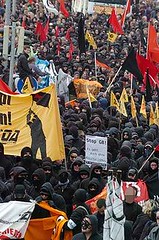
Every year or two, usually as a result of some media spectacle which has less-indoctrinated members asking all sorts of silly questions, Trotskyist groupuscules are forced to issue a statement clarifying exactly why they’re ‘right’ and “anarchism” is ‘wrong’. Almost invariably, this involves blowing the dust off an earlier issue of the Workers’ Mop & Bucket, and republishing the pro forma letter contained therein; said letter clarifying exactly why they were ‘right’ and anarchism was ‘wrong’ at whichever point in time the last minor incident occurred.
Is there anything more tedious?
Perhaps. My first nomination is the latest installment in this dreary series, titled, in the rhetorical fashion that Trotsykist writers apparently believe is mandatory (and for all I know may in fact be included in chapter one verse one of The Leon Trotsky Bumper Book of Party Rhetoric) ‘Is there anything radical about anarchism?’ (Socialist Alternative, No.117, June 2007). It’s written by Mick Armstrong, who’s been involved in this particular brand of politicking since the 1970s… and who has a strange aversion to Kiwi anarchists, and spies them lurking, like Spiny Norman, around every corner…
But that’s another story.
Introduction
Invariably, in the post-WWII period, some form of ‘socialism’ has gained a following among Australian university students, especially among those repelled by the horrors of global capitalism: environmental destruction; ‘Third World’ poverty; imperialist wars; rampaging transnational corporations; their parents. In the wake of the collapse of Communism in Eastern Europe, and the abandonment of any pretence of allowing radicals to eke out a career in reformist Labor parties — and in the absence of a better idea — joining a Trotskyist party can appeal to some fraction of these same repulsed students; especially those who imagine themselves wearing leather jodhpurs and heroically leading — or in some other fashion orchestrating — the exercise of collective forms of action by the working class.
Anarchists, on the other hand, have generally got more smarts. And smarts, unfortunately, is one thing lacking from Mick’s critique, one which, as suggested above, adopts a highly conventional — which is to say unoriginal — approach, and whose chief criticisms consist of the following:
According to Armstrong, “anarchism” is:
1) ideologically incoherent;
2) politically naive;
3) deeply antagonistic to working class people and their interests and;
4) centred on the pursuit of a particular ‘lifestyle’ under capitalism.
In essence, ‘anarchism’, it is argued, is little more than a radical form of bourgeois liberalism.
IdEoLoGiCaLiNcOhErEnCe
Of the first criticism, ideological incoherence, one might respond as follows:
One of the problems in writing about socialism is the sheer variety of political currents that adopt the label. On the far right we have neo-Nazis committed to a “no-Jews-thanks” national socialism. This branch of socialism opposes any interference by “the Jews” in the exercise of a White man’s right to exploit non-Whites for his own personal gain, and supports the defence of Race and Nation from Jewish domination — by any means necessary. For these socialists, any restriction on the freedom of Jews like Rupert Murdoch to go on raking in billions is sehr gut…
Such a response mirrors Mick’s approach to the problem of actually defining ‘anarchism’, an approach which serves to not only render anarchism — understood as being something other than a form of right-wing libertarianism — slightly kooky (if not simply distasteful), but also signally — and dishonestly — fails to recognise that such a bogus interpretation is actually rejected by anarchists, precisely because of its absurdity. Instead, we are presented with a false image of anarchism as constituting a spectrum of opinion, which exists on an imaginary axis ranging from ‘left’ (the syndicalists, many of whom “entirely reject the anarchist label and call themselves socialists or Marxists”!) to ‘right’ (bourgeois intellectuals such as Murray Rothbard). Again, this approach is hardly novel. It finds sustained endorsement in, for example, Ulrike Heider’s Anarchism: Left, Right, And Green (City Lights Books, San Francisco, 1994); the original and accurate title for which is Die Narren die Freiheit: Anarchisten in den USA heute (1992). More importantly, Mick’s approach fails to engage in any real sense with anarchism, either as ideology or as movement, and in either its historical or contemporary forms. In short, Mick is a bad Marxist, and adopts an ‘idealist’ rather than a ‘materialist’ approach to his supposed object of critique.
Anarchism and (Anti-)Politics
After noting that the (quasi-)anarchist syndicalists are ‘good’ anarchists because they, unlike the free marketeers and the ‘lifestylists’, “largely agree with the Marxist critique of capitalism and look to collective working class action to change the world”, Mick cites the syndicalists’ chief weakness as being their aversion to ‘politics’; in other words, their supposed resistance to developing “a clear working class political leadership”… one which might just include, one suspects, Mick himself. In truth, however, the matter is more complicated, and the rejection of ‘politics’ — understood as being a project centred on the acquisition of power via hierarchical institutions such as the state — is actually a disposition widely shared among anarchists, whether ‘syndicalist’ or of some other complexion. On the other hand, anarchists are engaged in a politics of everyday life, a political project often confused, unfortunately, with its disembrained counterpart: ‘lifestyle anarchism’.
Note that syndicalism (syndicat being French for union), and in particular anarcho-syndicalism, is just as often referred to as being a method used by anarchists to further anarchist goals as it is a particular school of anarchist philosophy.
Lifestyles of the Rich & Famous
“Karl Marx is always approached as so many thoughts, so many words. But in this case, as for every other, there is a lurking question: What of real life? What connection is there between lived choices — one’s willful lifetime — and the presentation of one’s ideas?” ~ John Zerzan, ‘The Practical Marx’, Elements of Refusal (Second Edition), CAL Press/Paleo Editions, 1999
According to Mick, “very few of today’s self-styled anarchists identify as syndicalists. The predominant currents are various forms of lifestyle anarchism which in turn merge into “autonomism” and/or the masked Black Blocs with their terrorist-style antics”.
If this statement were intended to form part of an application for the job of tabloid media commentator, I would applaud Mick for his sound political instincts. Unfortunately, this statement is intended to form the beginnings of a serious critique of contemporary anarchism… and it really doesn’t get any better than this.
Predictably, Mick cites Murray Bookchin on ‘lifestylism’, Bookchin’s most sustained attack on this dread disease being Social Anarchism or Lifestyle Anarchism: An Unbridgeable Chasm. Originally published 12 years ago, Mick quotes a passage from the first segment of Murray’s tome, reproduced here in full:
In the traditionally individualist-liberal United States and Britain, the 1990s are awash in self-styled anarchists who — their flamboyant radical rhetoric aside — are cultivating a latter-day anarcho-individualism that I will call lifestyle anarchism. Its preoccupations with the ego and its uniqueness [a clumsy reference to Max Stirner‘s Der Einzige und sein Eigenthum (1844)] and its polymorphous concepts of resistance are steadily eroding the socialistic character of the libertarian tradition. No less than Marxism and other socialisms, anarchism can be profoundly influenced by the bourgeois environment it professes to oppose, with the result that the growing ‘inwardness’ and narcissism of the yuppie generation have left their mark upon many avowed radicals. Ad hoc adventurism, personal bravura, an aversion to theory oddly akin to the antirational biases of postmodernism, celebrations of theoretical incoherence (pluralism), a basically apolitical and anti-organizational commitment to imagination, desire, and ecstasy, and an intensely self-oriented enchantment of everyday life, reflect the toll that social reaction has taken on Euro-American anarchism over the past two decades.
Bookchin’s diatribes on this strange beast called lifestyle anarchism have been dissected by Bob Black, among others, and I’ve no desire to do so again here. In any case, whatever their merits, Mick merely uses Bookchin to bash ‘anarchists’ over the head with, and this passage does little, if anything, to support Mick’s argument. Thus on the supposed influence of ‘lifestyle anarchism’ on the (Australian) environmental movement, Mick claims:
Some environmental activists have been influenced by this approach, combining individual lifestyle politics with efforts to “create living alternatives to our present ways”. Hence the emphasis on “affinity groups” (usually just another name for friendship circles), consensus, squatting, hostility to driving cars, not eating at McDonalds, veganism etc.
Aside from reflecting Mick and his party’s frustration at its exceedingly limited and continuing inability to recruit from this milieu, what we are presented with here is in a fact a parody of the critique of consumerism and industrialism, as well as the history of the modern environmental movement in Australia; its origins, influences, organisational forms and practices. Affinity groups, for example, have their origins among Spanish anarchist-communists of the late nineteenth century; consensus decision-making, on the other hand, is one of a number of organisational forms employed by environmentalists (one which, notably, has its origins outside of anarchism); squatting is a global practice of the poors, with only a tangential relationship to contemporary Australian environmentalism; ‘hostility to driving cars’ might be more sensibly read as a critique of the dominance of private transportation over urban and rural environments, industry, and planning; and the most notorious campaign against McDonald’s was led by two anarchists, Helen Steel, a former gardener, and Dave Morris, a former postal worker, a campaign which, moreover, focused on a whole range of vital issues, ranging from diet and nutrition, to advertising and propaganda, animal welfare and environmental preservation, to employment conditions and workers’ rights.
From an anarchist perspective, a better question would be to ask ‘what are the ways in which you-and-I may live, love, hate and struggle in order to lead the life and to bring about the kind of society that you-and-I desire’? The distinction that Mick makes between “how we live our lives [and] the best means of winning a struggle”, in other words, is a false dichotomy, one which “challenges no aspect of [a] repressive and exploitative society”, but rather reinforces the seperation between means and ends, and hopelessly confuses the nature of prefigurative politics.
Finally, Mick also claims that lifestylism “usually goes hand in hand with the dismissal of workers as at best bought off or at worst, according to Bookchin, as “our enemies”.” Well, that maybe so. Further, if one accepts the caricature of anarchism that is ‘lifestyle anarchism’, one might, from a working class perspective, condemn ‘anarchism’ too on that basis. As it stands, however, ‘anarchism’ does no such thing; certainly, the relationship between anarchism and working class consciousness — and the role of workers as a class in the reproduction of contemporary capitalist society — is a far more complex matter than this supposed condemnation of workers’ apathy and essential political conservatism suggests; and so, too, are anarchist and anarchist-influenced understandings of such questions.
Reductio ad absurdum
“The most logically consistent form of anarchism is absolute individualism.”
In attempting to demonstrate the radical absurdity of anarchism, Mick cites the work of two dead anarchists: Mikhail Bakunin (1814–1876) and Emma Goldman (1869–1940). And like other bourgeois writers, Mick describes Bakunin as being “one of the founders of anarchism”, while Goldman, on the other hand, must content herself with being “still very popular among anarchists today”. In any case, the work of these two writers, it is to be presumed, lays a proper basis for understanding anarchist ideology, and therefore provides ample means by which Mick may safely demonstrate its lack of ‘radicality’.
“Freedom,” wrote Michael Bakunin… “is the absolute right of every human being to seek no other sanction for his actions but his own conscience, to determine these actions solely by his own will, and consequently to owe his first responsibility to himself alone.”
But there is nothing radical in this argument. It is used to justify every conceivable form of anti-social behaviour: the right of the well-off to send their kids to elite private schools, the right of scabs to cross picket lines, the right of racists to spew their filth, the right of business owners to despoil the planet and exploit workers.
This portion of his anti-anarchist diatribe would appear to be the result of plagiarism on Mick’s part, the lazy bugger, as an eerily similar passage — following the same quote by Bakunin — may be found in an earlier critique of revolutionary anarchism scribbled by one of his Yanqui comrades, Paul D’Amato (‘Anarchism: How Not to Make a Revolution’, International Socialist Review, No.4, Winter 1997):
There is nothing radical in this proposition – it has been used to justify the right-wing’s attack on the welfare state, the right of billionaries to make their billions without interference, the superiority of the chosen few over the ‘mass’, and the right of scabs to cross a picket line.
Then again, perhaps Mick’s simply attempting to demonstrate his Green credentials by recycling old passages into new? In any event, it appears that this quote (Mick provides no attribution) is actually taken from Bakunin’s 1866 text ‘The Revolutionary Catechism’, which Sam Dolgoff (Bakunin on Anarchism, Black Rose Books, 2002, p.76) translates as follows:
III. Freedom is the absolute right of every adult man and woman to seek no other sanction for their acts than their own conscience and their own reason, being responsible first to themselves and then to the society which they have voluntarily accepted.
Note that ‘The Revolutionary Catechism’ was one of the first texts Bakunin produced as a mature anarchist, having been at first, like Marx, a follower of Hegel, and then an exponent of ‘revolutionary pan-Slavism’. Note also that the above translation is both fuller (it includes the passage as a whole) and makes explicit reference to the free adult’s responsibility to society. Finally, note that the next two passages, as translated by Dolgoff, read as follows:
IV. It is not true that the freedom of one man is limited by that of other men. Man is really free to the extent that his freedom, fully acknowledged and mirrored by the free consent of his fellowmen, finds confirmation and expansion in their liberty. Man is truly free only among equally free men; the slavery of even one human being violates humanity and negates the freedom of all.
V. The freedom of each is therefore realizable only in the equality of all. The realization of freedom through equality, in principle and in fact, is justice.
Briefly then: Bakunin’s assertion that the first recourse of human freedom is reason and the individuals’ conscience is ‘radical’ in two senses. First, it is stated emphatically. (In fact, there are numerous other texts by Bakunin which make the same case in even stronger terms.) Further, it’s a concept ultimately derived from the Enlightenment, a period many consider as marking the birth of the modern era, and as such, a radical departure in human history. (“Freedom, morality, and the human dignity of the individual consists precisely in this; that he does good not because he is forced to do so, but because he freely conceives it, wants it, and loves it.”) Secondly — and herein lies its relative novelty, as well as notoriety — Bakunin embeds the concept of human freedom very firmly in the intimately related concept, both for Bakunin and for anarchists generally, of equality. Such a notion is perhaps best summarised in his famous dictum: Liberty without socialism is privilege, injustice; socialism without liberty is slavery and brutality.
So. To cut a long story short. The fact that in Melbourne, for example, the well-off send their kids to elite private schools, that many of these kids then go on to study at The University of Melbourne, and that upon arrival some of these kids join socialist parties, really has bugger-all to do with Bakunin, and a whole lot more to do with middle-class guilt.
Back with another one of those Bloc knockin’ bleats
Obviously, the black bloc has captured the public’s imagination — which is a bad thing, and detracts from sales. It’s also apparently a pure expression of “absolute individualism”, and not only that, but of contempt for “democracy” — which is also a bad thing (and detracts from sales). Thus according to Mick:
…Black Bloc anarchists… specialise in violent attacks on the symbols of authority. In Europe there has been a recurring pattern of masked squads of Black Bloc anarchists disrupting mass protests with provocative attacks on police, smashing up banks with iron bars and the like.
These antics have been remarkably effective in sabotaging genuine protests and imperilling the lives of other protesters – but singularly ineffective in challenging capitalism. All they have done is play into the hands of the authorities who use the mindless violence of the Black Blocs as an excuse to crack down on all dissent. Unsurprisingly the Black Blocs are riddled with undercover police acting as provocateurs.
Mick’s all-too-brief analysis of ‘black bloc anarchists’ may find support among the few hundred university students who form his party’s membership, and who remain largely ignorant of the recent history of European radical social movements. It could also be found in any number of tabloid treatments of the same subject. But as history, it is, as Henry Ford might say, bunkum.
To begin with, and briefly, a ‘black bloc’ is a tactic, a protest formation consisting of x number of people clad, as the name suggests, in black, and marching together, forming a bloc. What black blocs ‘specialise’ in is given by what they do, and in the context of protest marches, while this sometimes involves property damage, it may also mean, more simply, providing some degree of protection to its membership from police and fascist violence, as well as a degree of tactical cohesion that would otherwise be lacking. Further, it would be a mistake to make an overdetermination, as Mick does, of the political meaning and significance of the black bloc, as in practice this tactical formation has been utilised by a range of groups, with sometimes disparate ideologies.* Finally, any such attribution would first have to acknowledge that this social phenomenon, like all others, has a history, and of the hundreds if not thousands of occasions upon which black blocs have formed over the last two to three decades, to characterise this history as having as its most salient features the ‘disruption’ of mass protests, the launching of ‘provocative’ attacks upon police, and the ‘endangering’ of the lives of other protesters is not only inaccurate, but a stupid, vicious lie.
*At the S11 protest against the WEF in Melbourne in September 2000, SocAlt, seeking to capitalise upon the media’s fascination with the ‘black bloc’, attempted to ape ‘anarchist’ imagery by forming a ‘red bloc’; a practice which they apparently have continued to pusue, most recently at G20.
In reality, the origins of the ‘black bloc’ may be found in the development of confrontations between ‘autonomist’ movements and the state, in particular those which took place in Germany in the early 1980s. The ‘black bloc’ was ‘spontaneous’ in the sense that it emerged partly as a result of a pre-existing preference among young radicals to wear black (and given the supposed inclination of Melbournians to do the same, perhaps Mick has a right to be worried?), and a desire to defend movement projects and street protests from state, and later neo-Nazi, assault. Or as Daniel Dylan Young describes it:
In response to violent state oppression radical activists developed the tactic of the Black Bloc: they went to protests and marches wearing black motorcycle helmets and ski masks and dressing in uniform black clothing (or, for the most prepared, wearing padding and steel-toed boots and bringing their own shields and truncheons). In Black Bloc, autonomen and other radicals could more effectively fend off police attacks, without being singled out as individuals for arrest and harassment later on. And, as everyone quickly figured out, having a massive group of people all dressed the same with their faces covered not only helps in defending against the police, but also makes it easier for saboteurs to take the offensive against storefronts, banks and any other material symbols and power centers of capitalism and the state. Masking up as a Black Bloc encouraged popular participation in public property destruction and violence against the state and capitalism. In this way the Black Bloc is a form of militance that mitigates the problematic dichotomy between popularly executed non-violent civil disobedience and elite, secretive guerilla terrorism and sabotage.
For more on autonomist movements in Western Europe, see George Katsiaficas, The Subversion of Politics: European Autonomous Social Movements And The Decolonization of Everyday Life (Second Edition), AK Press, 2006; a useful if typically hostile (to anarchism) account written by a follower of Marcuse.
“Behind you!” Anarchism and Terrorism
“I would rather kill chickens than kill kings. Chickens are good to eat. But a king, of what use is he?” ~ Errico Malatesta
Not unexpectedly, Mick repeats the routine assertions of the bourgeois regarding the relationship between anarchism and political violence, assertions which, while unsupported — and almost always unexamined — are brought back into mainstream circulation as often as they are required. (See, for example, Mary Evans, ‘For jihadist, read anarchist’, The Economist, August 18, 2005.) Most recently, the emergence in the West of movements against neo-liberalism — and, following that brief episode, the sudden irruption into public consciousness of Islamic fundamentalist terror — has rekindled bourgeois interest in this topic, and Mick, once again, is no exception. Further, according to Mick, this supposed reliance of anarchism on the commission of individual acts of terror is, he argues, the inevitable result of its underlying ‘elitism’; for which reason, “rather than attempting to organise the mass of workers to fight for their own self-emancipation, [anarchists] rely on the actions of a self-chosen minority”.
Both contentions are radically false.
To begin with, the extent of anarchist terrorism has long been exaggerated, in fact massively so. The reasons for this are not that difficult to fathom, and are closely intertwined with the role of the anarchist monster as the bringer of ‘chaos’ and ‘destruction’ in the bourgeois imagination; in reality, the overthrow of bourgeois rule. Further, anarchism is not the only political tendency which has produced ‘terrorists’. For example, if one compares the nature and extent of anarchist acts of violence, even during their peak, anarchism emerges as one of the least violent of political traditions. And of those whom the anarchists did murder, the great majority were kings and presidents. Thus the years 1892 to 1901 are sometimes referred to as The Decade of Regicide. Those who kicked their gold-plated buckets at this time included President Sadi Carnot of France in 1894, Prime Minister Antonio Cánovas of Spain in 1897, the Empress Elizabeth of Austria in 1898, King Humbert of Italy in 1900, and President William McKinley of the United States in 1901.
In summary, Richard Bach Jensen writes:
While the number of assassinated heads of state and government, and of monarchs of major countries was unprecedented, the anarchists, outside of Spain, killed relatively few people. Nonetheless, the anarchists’ desire for dramatic signs of vindication, the authorities’ and the public’s fears of a vast anarchist conspiracy and the media’s hunger for sensational news combined to create the mirage of a powerful terrorist movement sweeping through nations and across the world. ~ ‘Daggers, Rifles and Dynamite: Anarchist Terrorism In Nineteenth Century Europe’, Terrorism and Political Violence, Vol.16, No.1, Spring 2004, pp.116-153
In fact, according to Jensen’s calculations, in 1890s France, Spain and Italy — the three countries in which the majority of dastardly anarchist outrages such as these took place — “real or alleged anarchists killed more than sixty and injured over 200 people with bombs, pistols and daggers”. Further, while “No one has yet attempted to calculate the total number of European and world victims of anarchist terrorism… [f]or the period 1880-1914 (excluding Russia) about 150 people died and over 470 were injured as a result of real or alleged anarchist attacks”.
By way of comparison, one might consider the many casualties that wars produced during the period 1880-1914. For example, four times as many Australians (606) died helping to keep South Africa British in the Anglo-Boer war of 1899-1902 than anarchists allegedly killed during this entire period; casualties in the Herero War in German Southwest Africa (1904-07) totalled 75,000; while Mike Davis (Late Victorian Holocausts: El Niño Famines and the Making of the Third World) argues that the business policies of the imperial European landlords, merchants and bureaucrats in the face of the El Niño drought intensified these famines and thereby caused millions of deaths during the period 1876-1900. Then again, given that Socialist Alternative is a Trotskyist groupuscule, one might compare these acts of terror with that unleashed by the Bolsheviks against their revolutionary — and often anarchist — opposition following their coup d’état in 1917.
On Elites
The members of this Elite are either direct incarnations of the fourth-dimensional Prison Warders or have their minds controlled by them. ~ DaViD iCkE
Having supposedly found confirmation of the elitist nature of anarchist practice in the attentats of the 1890s, Mick claims to have discovered its starkest theoretical confirmation in an essay by Emma Goldman, ‘Minorities versus Majorities’, from which he derives the following (mis-)quote:
The multitude, the mass spirit, dominates everywhere, destroying quality… The majority cannot reason; it has no judgement. Lacking utterly in originality and moral courage, the majority has always placed its destiny in the hands of others… I therefore believe with Emerson that ‘the masses are crude, lame, pernicious in their demands and influence, and need not to be flattered, but to be schooled. I wish not to concede anything to them, but to drill, divide, and break them up’, and draw individuals out of them. Masses! The calamity are the masses. I do not wish any mass at all, but honest men only, lovely, sweet, accomplished women only. In other words, the living, vital truth of social and economic well-being will become a reality only through the zeal, courage, the non-compromising determination of intelligent minorities and not through the mass. ~ ‘Minorities versus Majorities’, Emma Goldman, Anarchism and Other Essays (Third revised edition, New York: Mother Earth Publishing Association, 1917)
In analysing Goldman’s views as expressed in ‘Minorities’, Mick ignores her central thesis, which has bugger-all to do with her beliefs in the revolutionary capacities of the masses, and everything to do with her seeking to explain the reasons for its relative absence in US society in 1917, characterised as this period was by patriotic hysteria, war fever, and the Red Scare. Indeed, US Government and media-induced fears of foreign agitators in the late 1910s find a contemporary echo in Mick’s own phantasies about the involvement of same in the G20 protest in November 2006:
What gave [“the anarchist crazies involved in the ultra-violence”] a certain critical mass at the G20 was the presence of considerable numbers of anarchists from overseas. One of our members from New Zealand said he recognised at least 40 NZ anarchists. He knew at least 20 of them by name. There were also a considerable number of black [bloc] anarchists from Europe. We know of people from Sweden, Germany and England. These people are like football hooligans who travel the world looking for violence.
Goldman’s essay might better be understood, then, as standing in a much longer tradition, one which might find its earliest expression in Etienne de la Boetie’s Discourse on Voluntary Servitude (1548), but which also finds a prominent place in the Marxist tradition, in the Frankfurt School notably, but among critical theorists more generally. And one of the central tasks of these theorists has been to understand the ways in which culture shapes working class consciousness, and to explain the reasons for its apparent absence as a force for the revolutionary transformation of capitalist society.
It should also be noted that Goldman’s family was hounded from Russia by pogromists, and that xenophobic sentiment in the US was not confined to words, but in Emma’s case resulted just two years after she wrote her essay in the deportation of herself and over 200 others (the majority of them members of the Union of Russian Workers) back to Russia.
But leaving aside the strengths and weaknesses of her argument, as well as questions of class, culture and consciousness, it’s a blatant and easily demonstrable lie to claim, as Mick does, that “the conclusion for anarchists like Goldman is identical to that of conservatives — opposition to mass, democratic control from below: the working class can’t and shouldn’t rule”. In reality, one of the reasons we know her name at all is because Red Emma, from the time she was a teenager, was a rebel and a working class revolutionary. In other words, Mick is pissing on the memory of an immigrant working class Jewish woman who dedicated her entire life to working class revolution. Further, as Gordon Edgar notes:
Emma Goldman became famous because there was mass working class organizing and activism. Without downplaying her extraordinary speaking abilities, tireless fundraising and ability to rise above societal restrictions due to her gender, ethnic background, and class, if there had been no revolutionary working class movement at the end of the nineteenth century, we would not know the name Emma Goldman. ~ ‘How Can They Make History So Boring? Emma Goldman, May Day, and The American Experience’, hip Mama
Such willful historical falsification is not an aberration of Mick’s, but lies at the heart of attempts to justify the Leninist conception of revolution and revolutionary organisation; or what Mick calls “Marxism”.
“Marxism”
In the final part of his critique questioning the ‘radicality’ (nowhere defined) of anarchism, Mick proceeds to outline the orthodox Leninist path to state power. This is a path strewn with many difficulties, of course, the most glaring of which, for Mick at least, is the task of transforming a few hundred mostly university students “into the most politically conscious workers”, and from that point “to challenge the hold of reformist parties and union leaders” over the hearts and minds of the Australian working class.
Good luck.
As for Karl Marx’s “considerable experience of the disastrous impact of anarchists on the early working class movement”, the bourgeois intellectual and his factory-owning sidekick Engels (from 1838 on a representative of the firm of Engels and Erman, and a full-time capitalist throughout the 1850s and ’60s in Manchester) were right to be scared, and it was precisely because of the anarchist’s radicality that they despised them. As John Zerzan notes:
Turning back to politics, the economic crisis Marx avidly awaited in the ’50s had come and gone in 1857 awakening no revolutionary activity. But by 1863 and the Polish insurrection of that year unrest was in the air, providing the background for the formation of the International Workingmans’ Association. Marx put aside his work on Capital and was most active in the affairs of the International from its London inception in 1864. Odger, President of the Council of all London Trade Unions, and Cremer, Secretary of the Mason’s Union, called the inaugural meeting, and Wheeler and Dell, two other British union officials, formally proposed an international organization. Marx was elected to the executive committee (soon to be called the General Council), and at its first business meeting was instrumental in establishing Odger and Cremer as President and Secretary of the International. Thus from the start, Marx’s allies were union bureaucrats, and his policy approach was a completely reformist one with “plain speaking” as to radical aims disallowed. One of the first acts of the General Council was the sending of Marx’s spirited, fraternal greetings to Abraham Lincoln, that “single-minded son of the working class”…
The weaknesses and contradictions of the adherents of Proudhon and Bakunin are irrelevant here, but we may observe 1869 as the highwater mark of the influence of Marx, due to the approaching decline of the Proudhonists and the infancy of Bakunin’s impact in that year. With mid-1870 and the Napoleon ill-engineered Franco-Prussian War, we see once more the pre-occupation with “progressive” vs. “non-progressive” military exploits of government. Marx to Engels: “The French need a drubbing. If the Prussians are victorious then centralization of the working class… the superiority of the Germans over the French in the world arena would mean at the same time the superiority of our theory over Proudhon’s and so on.”
…The defeat of France brought the fall of Louis Napoleon and his Second Empire, and a provisional Republican government was formed. Marx decided that the aims of the International were now two-fold: to secure the recognition of the Republican regime in England, and to prevent any revolutionary outbreak by the French workers.
His policy advised that “any attempt to upset the new government in the present crisis, when the (Prussian) army is almost knocking at the door of Paris, would be a desperate folly.” This shabby, anti-revolutionary strategy was publicly promoted quite vigorously — until the Commune itself made a most rude and “unscientific” mockery of it in short order.
Well-known, of course, is Marx’s negative reception to the rising of the Parisians; it is over-generous to say that he was merely pessimistic about the future of the Commune. Days after the successful insurrection began he failed to applaud its audacity, and satisfied himself with grumbling that “it had no chance of success.” Though he finally recognized the fact of the Commune (and was thereby forced to revise his reformist ideas regarding proletarian use of existing state machinery), his lack of sympathy is amply reflected by the fact that throughout the Commune’s two-month existence, the General Council of the International spoke not a single word about it.
It often escapes notice when an analysis or tribute is delivered well after the living struggle is, safely, living no longer. The masterful polemicizing about the triumphs of the Commune in his Civil War in France constitutes an obituary, in just the same way that Class Struggles in France did so at a similarly safe distance from the events he failed to support at the time of revolutionary Paris in 1848.
At the end of the nineteenth century, anarchism was neither “a beautiful vision of saintly dreamers” nor “a sick social ideology” — as Mick maintains — but a practical form of working class struggle against the rule of both capital and state. As such, it has constituted one of the political alternatives to Marxism. And while Marxist movements have undergone periodic crises of faith — in 1917, 1921, 1939, 1948, 1956 and 1968 in particular, but on many other occasions — since the collapse of Communism in Eastern Europe in the late ’80s and early ’90s, this crisis has become particularly acute.
Throughout this period, from its emergence in the 1800s until now, anarchism has been characterised by various bourgeois forces, including Marxist ones, as ‘sick’, ‘primitive’, ‘infantile’… and yet, it moves! According to Mick, however, those “seeking to genuinely challenge capitalism must reject anarchism and commit themselves to revolutionary Marxism — the politics of mass, democratic struggle of workers to collectively transform society”. Well, that’s the “theory”. Most recently, in practice, ‘genuinely challenging capitalism’ has apparently meant denouncing protesters at the G20, and demanding that “the left should offer no comfort to these crazies”, doing “whatever we can to isolate them”. On my reading, such an hysterical reaction suggests that Mick’s party-building exercises are in reality as fragile as the ideology which endorses it is threadbare. Little wonder, then, that “the kids” are in danger of slipping from his grasp, and becoming free to explore more fruitful avenues of subversion.
Enjoy.