[Update (April 27, 2023) : From IGA to the ARIAs – via Glastonbury and Gucci: Amy Taylor’s rockin’ rise, Konrad Marshall, The Sydney Morning Herald, December 3, 2022: ‘They opened the Sydney Festival in January [2022], for instance, unaware the event had financial support from the Israeli government, or that a huge boycott was in effect. Some in the punk community branded the band Zionists[?], accusing them of taking blood money. “I’m glad we got a slap on the wrist, because we could walk away having learnt something,” Taylor says. “We made a mistake. Sometimes you just have to admit you don’t know something. But it’s hard sometimes, because I’m the centre of the tornado.” A natural autodidact, Taylor dove down a Middle-East-conflict rabbit-hole, reading the graphic novel Palestine by Joe Sacco, listening to the Palestine Remembered podcast, and donating the band’s festival fee to the Olive Kids foundation, which supports Palestinian children. “I didn’t start reading the news until two years ago, but I’m hugely interested. It’s dope. It’s important,” she explains. “I hadn’t heard about The Troubles before either, so then I go, ‘What’s that?’, and all these puzzle pieces start clicking together. But you make a misstep and you get moral panic.”’.]
[Update (January 16, 2022) : A Jewish Response To The Sydney Festival Boycott, Do Better On Palestine, January 16, 2022 /// (January 14, 2022) : Benjamin Law quits Sydney Festival board following Israeli funding controversy, Robert Moran and Linda Morris, The Sydney Morning Herald, January 14, 2022 | Sydney Festival chair apologises over festival board’s handling of Israeli sponsorship issue, Hamish McDonald, Katie Hamann, Dunja Karagic and Simon Leo Brown, ABC, January 13, 2022 /// (January 11, 2022) : From Safsaf to Sydney: Palestinian resistance and the festival boycott, Jeanine Hourani, Rihab Charida and Matt Chun, Overland, January 11, 2022.]
As you may already be aware, the Sydney Festival — ‘one of Australia’s largest annual cultural celebrations’ — is currently taking place. The Festival (January 6–30) is also the subject of a boycott, called on behalf of Artists Against Apartheid, because the Festival’s Board ‘made the decision to accept funding from the Embassy of Israel, making the embassy a Star Partner’. A large number of artists and performers have responded to the call. For its part the Board issued a motherhood statement.
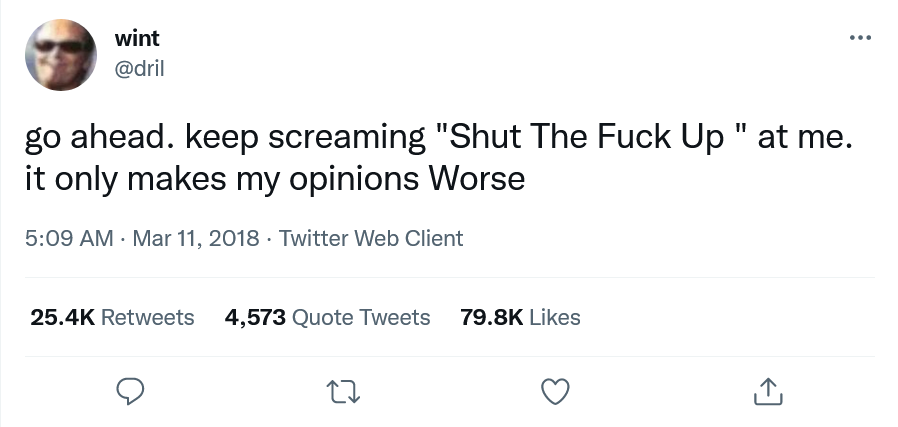
One artiste that elected to ignore the boycott was Melbourne band Amyl & The Sniffers (‘After an occasionally shambolic hour there’s no encore but that proves relatively easy to accept – the job of lighting a fire under the Sydney Festival has been emphatically accomplished‘). Their decision surprised some, but it also prompted me to make a meme, so y’know: win some, lose some.
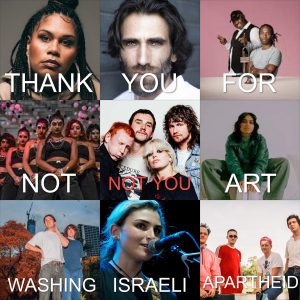
For what it’s worth, in 2022 I reckon The Sniffers are Too Big To Fail, and the moment will soon be forgotten, but I remain curious as to why they felt compelled to play; you can read Tropical Fuck Storm’s (slightly grumpy) announcement they’d be pulling the plug on their gig here.
See also : Support the work of artists who withdrew from Sydney Festival. | Sydney Festival Hit by Claims of Art-Washing Over Israel Sponsorship, Patrick Frater, Variety, January 7, 2022 | Gene Simmons, Deborah Conway join opposition to Sydney festival boycott as more acts pull out, Kelly Burke, The Guardian, January 7, 2022 | Sydney Festival boycott: when arts organisations accept donations, there is always a price to pay, Jo Caust, The Conversation, January 6, 2022 | Sydney Festival pays price for Israeli sponsorship, The Australian Jewish News, January 5, 2022 | High-profile figures join Sydney Festival boycott over Israeli funding, Nick Galvin, The Sydney Morning Herald, December 23, 2021.

*For those who’d like to learn a little bit about blak history and Black-Palestinian Solidarity, see : Black-Palestinian Solidarity conference: Contesting settler nationalisms, Gary Foley and Suzannah Henty, Radical Philosophy, Spring 2020:
Black-Palestinian solidarity in the continent emerged during the late 1970s and began with the organised political actions of Ali Kazak and Gary Foley. Kazak, an activist, former Fatah member and, later, Palestinian Liberation Organization representative for the Oceania region, migrated to Australia in 1970. Foley is a Gumbaynggirr activist, historian, and co-founder of the Redfern Aboriginal Legal Services (1971) and the Aboriginal Tent Embassy (1972). Both Kazak and Foley saw the Palestinian and Aboriginal struggle for justice against settler-colonial occupation as united. Their shared militant, anti-imperialist, and internationalist actions against the occupiers and their beneficiaries held solidarity at the heart of their revolutionary decolonial imaginaries.