The Stormfront Down Under Circus : 2004–2008

It’s been a while since I cast a weary eye over Stormfront Down Under, so recently I thought I’d take a peek to see how things are faring for our racist friends, especially since former Yanqui Co-Moderator jack_boot let go of Paul Innes’ hand, and let him have the Forum to himself. For the benefit of those of you arriving late, here, briefly(?), is a little recent history:

2004/5
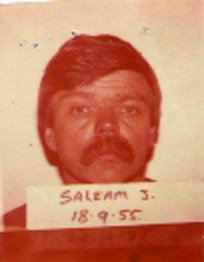

Above : Dr James ‘Jim’ Saleam

Insofar as anti-racist activity is concerned, the story of Stormfront Down Under really only begins in August 2004 (Stormfront as a whole was established by former KKK Wizard and international terrorist Don Black in 1995). In that year, the now-defunct Patriotic Youth League — an organisation for young friends of the white supremacist Australia First Party under Dr James Saleam — came to some small degree of public prominence (it was formed towards the end of 2002). In 2004, it had begun a campaign of placing racist posters and stickers on University campuses, which appeared in both NSW (University of Newcastle, Macquarie University) and Victoria (LaTrobe University, RMIT and the University of Melbourne). At around the same time, a number of African and Asian students at the University of Newcastle were verbally abused and physically assaulted (Campus racism rises, Sarah Price, Sun-Herald, August 29, 2004). These events took place against a background of heightened xenophobia; fuelled by the public hysteria over the 9/11 attacks on New York and Washington, the bombings in Bali in 2002, and further reinforced by the then HoWARd Government’s highly repressive policies on refugees (cf. the Tampa crisis).

The League’s principal spokesman was Stuart McBeth, a then-23-year-old Novocastrian and Salvation Army employee. McBeth and his group were linked to a range of far right organisations, including the US-based Volksfront (with which the group shared a PO Box), Blood & Honour, and, of course, Stormfront, on which a number of its members happily paraded their racist hatred and ignorance (Neo-Nazi link to campus anti-foreigner campaign, Matthew Thompson, The Sydney Morning Herald, August 31, 2004). For example, McBeth joined the Forum in September 2003 as ‘Eureka Spirit’, while Luke Connors posted as ‘young soldier’, joining in November 2004. During this period, Andrew Wilson functioned as the PYL’s representative in Sydney, while Connors did the same for Victoria.

The PYL was largely an Internet phantasy for those involved, but it did make some attempts to hold public rallies. In January 2005, for example, the PYL decided it would be a good idea to protest outside the HQ of a Sydney trade union. Upon being confronted by 50–60 counter-protesters, however, including a large number of unionists, the massed ranks of the PYL — all four of them, including Andrew Wilson — fled (Nazi Encounter, Port of call [Maritime Union of Australia: Workers Journal], March/April 2005). One person who didn’t attend the abortive Sydney rally — aside, of course, from its leader, Stuart McBeth — was Andrew Fraser. Fraser was shortly to come to notoriety for his concerns regarding the alleged criminality and low intelligence of blacks, but at the time he, along with Saleam, were on the ‘National Executive’ of the PYL. Or at least, that’s what the meat-headed Luke Connors claimed in an interview with a local “documentary filmmaker”.

Of course, the PYL weren’t the only members of Stormfront Down Under in its heyday. Others included Carl D. Thompson (posting as ‘Wodensvolk’). Thompson subsequently lost his job as editor of the One Nation Party publication The Nation after making some rather dubious assertions regarding his and Stormfront’s Public Enemy #1: The Jew. Also to feature on the site were Sue Bateman, posting as ‘Suebdoo2’, One Nation’s east metropolitan regional president in Perth and 2005 State election candidate (see Storm for One Nation poster girl, Gary Adshead, The West Australian, September 22, 2005), Sydney residents Peter Campbell (‘Kromlek of Asgard’/’ZyklonB’) and Darrin Hodges (‘Proud to be an Infidel’), and rural Queensland-based Jim Perren (‘Stug111’/’303SMLE’).

During 2005, SFDU was the subject of a few articles — Joe Hildebrand’s ‘Life as an uber fraud – the one race I won’ (The Daily Telegraph, October 29, 2005) being one of the more amusing — and also an equally amusing expose by FightDemBack! of a botched attempt by locals in Melbourne to hold a ‘Strictly Members Only’ BBQ. Needless to add, there have been very few such gatherings since. What really gave local white supremacists a shot in the arm, however, was the Cronulla pogrom in December 2005.

This episode was greeted with unabashed joy by the upright citizens on SFDU, and touted as heralding a new era for their scattered and tiny movement. Darrin Hodges (then a member of Saleam’s AF), AF and the PYL as a whole, for example, proudly trumpeted the affair as a ‘civil uprising’ against the multicultural tide. Luke Connors complained in the wake of the pogrom, “Mate, I’m going to get brain cancer from having the mobile phone pressed to me ear all day and all night. Answering membership and media inquiries.” Another member, James Newman (‘JN’), produced a video of the ‘uprising’, coupling captured images of the events with a soundtrack by neo-Nazi band Skrewdriver. It was also at this time that Darrin Hodges was first publicly exposed as being the SF user ‘Proud to be an Infidel’:

One active local member, who goes by the moniker “Proud to be an Infidel”, has been a regular contributor to international white supremacist organisation Stormfront.

Via a series of electronic footprints, anti-Nazi campaigner Mat Henderson-Hau has linked “Infidel” to Engadine local Darrin Hodges.

Hodges, who runs a website for a sex toy distributor, yesterday admitted to being a member of the racist Australia First Party but denied being a member of any white nationalist groups or a contributor to Stormfront.

His alleged alter ego is not so shy.

“Friends, today was an historic day, the day Australians stood up against state-imposed multiculturalism,” he wrote on the night of the Cronulla riots.

Accompanying his posting is a series of photographs he took at Cronulla that day, including one of a T-shirt emblazoned with the words “wog free zone” and another of a sign offering free sausages to the crowd, with “no tabouli”.

Infidel also speaks of footage he filmed on the day which Henderson-Hau believes was used in a video released over the weekend that glorifies a mob of rioters bashing various non-whites at Cronulla…

~ Joe Hildebrand, White supremacists casting a black cloud, The Daily Telegraph, December 20, 2005

The events and attempts to politically capitalise on them by white supremacists triggered a predictable reaction on the part of the NSW Government: White supremacist crackdown call (The Sydney Morning Herald (AAP), December 20, 2005). Also implicated at this time in racist fun and games were Andrew Sanders (‘blue8eyed8devil’ on SF) — who authored a website, Fightback [now belonging to others], dedicated to encouraging locals to take action against the Lebanese hordes — and his comrade-in-arms and fellow ‘Tunnel Rat’, Andrew Roach (Friend of accused’s vile words of hatred, Joe Hildebrand, The Daily Telegraph, December 22, 2005). The author of one of the Cronulla videos, James Newman, was also exposed at this time (Video man is security guard in city, Joe Hildebrand, The Daily Telegraph, December 22, 2005).

2006


Above : Darrin Hodges

The year 2006 naturally began with high hopes for the racists, fascists and bizarros on SFDU. After all, hadn’t the Australian masses just engaged in a civil uprising — “revolution” even — against ZOG and the symptoms of its multicultural machinations (see Nadav Shlezinger, “Victory in Cronulla”: What the neo-Nazis are saying, AIJAC Review, January 2006)? Unfortunately, it was at this point that the ethnic origins of one of the leaders of the forthcoming White Revolution was again exposed as being… well… not exactly ‘white’. And while Darrin Hodges first left and then later re-joined SF, another SF veteran, Peter Campbell, also chose this moment to retire from online battle. Further, just three months earlier (October 2005), the internet forum he helped to establish via the White Pride Coalition of Australia also collapsed.

In March 2006, Saleam’s party was subjected to no small degree of public ridicule by Dan Box, writing in The Australian (White supremacy in our backyard, March 4, 2006). As a result of the ensuing kerfuffle, Luke Connors, the meat-headed spokesman for the Melbourne branch of the PYL, resigned from what remained of the organisation. His main complaint, at the time, was the involvement of AF member Welf Herfurth in helping to organise the local, Australian franchise of the international neo-Nazi network Blood & Honour. (Replacing Connors — who had in turn replaced Stuart McBeth — as spokesman for the dwindling ranks of young patriots, was Lachlan Black of Canberra, a former ONP member. Note further that Connors and Herfurth have since kissed and made-up, the two of them declaring themselves to be ‘national anarchists’.)

In Brisbane, meanwhile, having failed to learn the lesson of their white brothers in Melbourne, a number of odds and sods on SFDU attempted to organise their very own BBQ. These were less than completely successful. (See also : Scumfront Brisbane : Comedy Central, September 7, 2006.) Racist dingbats in Adelaide, however, struck back on behalf of their Brisbane brothers, and distributed some SF posters and stickers in the City of Churches. Unfortunately, “A lot of them were taken down by the public”, said a local MP (aka ZOG stooge).

Otherwise, 2006 was a fairly quiet year for SFDU members. The much-anticipated one-year anniversary of the Cronulla pogrom turned out to be a bit of a fizzer — ‘Cronulla all quiet one year on’ read one headline (NEWS.com.au/AAP, December 10, 2006) — and was possibly even less exciting than the celebrations AF organised for Australia Day way back in January (and less than two months after the ‘uprising’ itself).

2007


Above : Rhys McLean

2007 was a truly bewildering year for SFDU. In January, a racist storm in the Tamworth teapot got the tosspots talking. A few months later, in March, SFDU habitué David Innes (‘Baron von Hund’) decided to hang up his tinfoil helmet — another victim of ‘white nationalist’ intrigue. Innes and his partner Lilith — appointed SFDU Moderator in December 2005, the first Aussie to be granted the privilege by the SF Yanqui overlords — had for several years played a key role in popularising (destroying according to their critics) Stormfront in the land Down Under, even hosting monthly BBQs at their home for a handful of locals, similarly dedicated to getting pissed and dementedly discussing destroying ZOG’s nefarious hold over White Australia.

The person deemed chiefly responsible for David’s temporary demise? Doctor James Saleam, of course, whom David had denounced on SFDU on account of his Middle Eastern ancestry.

Naturally, like a dog after a bone, Innes was back only a few months later. That is, before once again leaving, this time (June) taking the missus with him. (Those left behind subsequently accused David and Lilith of being FDB! stooges.) Not surprisingly, there was stiff competition among the manly Aryan hordes for the vacant Crown, and eventually — for reasons best known to themselves — the Yanquis picked one ’AustralianEuro’, a teenaged Novocastrian named Rhys McLean. In a show of gratitude for their two years of hard work, David and Lilith went Down the Memory Hole.

Rhys’s reign as King of SFDU was, sadly, to be a short one. An organiser for AF, Rhys made the horrible mistake of being photographed wearing a swastika armband and giving the fascist salute. What’s worse, these photographs mysteriously made their way into the hands of local ZOG agents FightDemBack!. Bad, yes, but worse was yet to come when in January 2008 Rhys starred in an article in The Daily Telegraph concerning plans hatched on SFDU to have a neo-Nazi knees-up on Australia Day (RSL slams Australia Day hijack, Joe Hildebrand, January 10, 2008). Within the space of a few days of its publication, Rhys too, was gone.

2008


Above : Sue Bateman and Paul Innes

Having lost first Lilith (Emma) and then Rhys (dummkopf), the American management team at SF was again forced to find a willing volunteer among the proud Aussies deemed worthy of the job. In an online poll, the two favourites nominated by locals were Carl D. Thompson — an unashamed neo-Nazi — and David Innes’ brother, Paul (‘Steelcap Boot’). And while the faces may have been changing, the sounds coming from SFDU remained very much the same. For a sample, see Australia, IMPORTED FKN SIMIAN PIECE OF NEGRESS CRAP, and lets get the ovens raised in melbourne.

On a lighter, non-genocidal note, the departure of John Drew from SFDU was probably one of the queerest moments in the Forum’s brief history. Queerer still, that at the time of his departure, Drew was the sole remaining member of the PYL. At well over 50-years-old, quite an achievement! (The PYL has since quietly folded, while Drew functions as AF in Queensland.)

Having been appointed Moderator, Paul Innes has overseen the rather precipitous decline in popularity of SFDU. The reasons for this are not, like those who post there, all that complicated. To begin with, its recent history is of one PR disaster after another. Secondly, those who post there are dimly aware — to the extent that they’re aware of anything much outside of their rank prejudices — that the Forum is crammed full of all kinds of fruits and nuts, traumatised teenagers, and creepy old neo-Nazis. As such, there’s always the risk that a fellow crank, angry at some slight, will let the cat out of the bag. This happened most recently in March, to Newcastle real estate agent and determined bigot Nathan Clarke (‘Nafe’ — also associated with AF in Newcastle).


Above : Nathan Clarke

A few final points.

SF is trying to clean up its act. For this reason, Mister Black has announced a new ‘no Nazi swastikas’ policy. Not unexpectedly, this hasn’t gone down too well with the locals who, like everyone else who examines the Forum, frankly don’t see the point. Consequently, a number of members have either left or been banned for protesting too loudly. (Carl D. Thompson is one example, but there are others.)

Secondly, Doctor James Saleam (‘radnat’) has made a heartfelt (or batshit crazy, depending on your perspective) appeal for information regarding the identities of some old Sydney-based boneheads in order to help him overturn his 1991 conviction for ordering a shotgun attack upon the then-ANC representative to Australia. What’s odd about the appeal is both its nature — why on Earth would anyone on SF have any knowledge of these individuals? And why couldn’t Herr Doktor simply alert his contacts in the English fascist movement instead? — but also its timing. Saleam is, apparently, intending to contest upcoming council elections in NSW on behalf of AF.

Best of luck.

Despite the removal of Nazi imagery on SF, the enimy remains — in keeping with the bizarro phantasies of chief ideologue David Duke — the Eternal Jew. How much longer SFDU will continue fumbling its way along is anyone’s guess, but it’s likely that as long as the cash keeps flowing, so will Mister Black and Mister Duke reserve a spot for the boys and girls Down Under to continue to spread their online filth.

Bonus! Jamie Kelso Loses His Mind!

Posted in !nataS, Anti-fascism, History, Media | 16 Comments

Skarpretter : Naziscum

See also : “I’d like to dedicate this next song to…”

“Skarpretter is a DIY fucking punk band that was formed in the autumn of 2004 in Ungdomshuset [1982–2007] and consists of 5 misfits of dubious character… Skarpretter is a Middle Ages word, meaning an official of the state appointed to carry out death sentences.”

NAZISCUM

Another black man loses his life on the street
A young punk goes down by knife in the east
The worst of vermin are on the rise

A little kid is beaten down outside her home
Onlookers don’t help, she takes the beating alone
They look away and ignore her cries

We’ve got an enemy to beat
We’ve got to meet them in the street
There’s a time to fight and that time has come
We’re coming for you, naziscum!

While another easy victim is left to die
The authorities, they turn a blind eye
Reports are filed and nothing is done

‘Cause these are the killers they themselves create
Ugly symptoms of a racist state
Like the father, so the son

And now they’re marching under the black flag
Stolen to replace a swastika filth rag
It seems they are too stupid to understand

That it represents the opposite of their ideology
The antifascist black flag of anarchy
Is not for their filthy hands

Meanwhile, in Russia…

    Dion, December 12, 2007: “As I stated on the [Bombshell] forum Andy, you are a liar, a hypocrite and no better than the trash that you fight against.”

Extremist Group Steps Up Pressure on Immigrants
Galina Stolyarova
The St. Petersburg Times
May 20, 2008

Members of the nationalist Movement Against Illegal Immigration (DPNI) launched a verbal attack on the pro-Kremlin United Russia party last weekend for introducing a series of reforms to the process of obtaining Russian citizenship.

Activists from the radical youth movement staged a protest outside the party’s local headquarters calling for an end to the reforms.

In April, the State Duma voted to support the first draft of the newly amended law on Russian citizenship that cancels the requirement for five-year residence in the country for former Soviet citizens permanently residing abroad and planning to relocate to Russia.

Under the new law, such applicants would no longer have to pass a Russian language exam or confirm their source of income.

The DPNI said that enabling mostly non-Slavic people to obtain citizenship would be, paradoxically, “a step that would inevitably result in the further growth of xenophobic sentiment in the country.”

“We do not want to believe that you are fully aware of all the negative consequences of such a move and that you really want this kind of future for the country, and therefore suggest that you use your influence to persuade the United Russia parliamentarians to end the plan,” reads the DPNI appeal to United Russia.

No official reaction has followed from United Russia.

Over the past several years the DPNI has been notorious for its nationalist rhetoric. Its website publishes a “crime watch” about crimes committed in Russia by non-Slavs.

The movement has also been involved in a number of street clashes with pro-tolerance movements.

Earlier this month, the Leninsky district court handed down suspended sentences to a group of anti-fascist activists responsible for starting a brawl with members of DPNI in September 2006.

The members of the “antifa” group — antifa refers to individuals and groups that are dedicated to fighting fascist tendencies — claimed responsibility for the street clash that resulted in three people being sent to city hospitals with stab wounds and head injuries.

Six members of the movement were tried on charges of a premeditated act of hooliganism.

Oleg Smirnov, Alexei Kogodovsky and Pyotr Osipov were each sentenced to a year in prison last Thursday, while Vyacheslav Sidorov and Maxim Khorkov were each sentenced to six months in jail. Igor Malyshev received six months in a labor camp. All the sentences were suspended.

The prosecution, which had demanded six years in prison for Smirnov and tougher punishments for the rest of the defendants, is planning to appeal the verdict.

The street fight was typical of the clashes between the two movements but it has become particularly notorious.

Violence broke out when activists from Antifa [sic] tried to disrupt a meeting of the DPNI on Pionerskaya Ploshchad on Sept. 17, 2006.

The meeting’s participants were expressing support for a race riot in the Karelian town of Kondopoga. The movement campaigns for the immediate deportation of immigrants from CIS countries.

Some members of the antifa group said they were driven to violence by the murder of Timur Kacharava, a student of the St. Petersburg State University and antifascist activist who was stabbed to death by a group of boneheads outside a bookstore on Ligovsky Prospekt in November 2005.

Timur’s killer, Alexander Shabalin, received 12 years in jail although the other members of the gang that attacked Timur were given suspended sentences.

“Yes, we did go there to disrupt their meeting, and yes, we were prepared to fight,” said Andrei, a witness to the fight and antifa member who asked that his last name be withheld to protect his safety.

“After the murder of Timur Kacharava we realized that fascists and nationalists understand only one language, the language of force,” he added. “If the authorities do nothing, we have nothing left to do but fight. We are aware of the fact that this makes us more vulnerable, but there doesn’t seem to be any other way of drawing attention to the problem. Verbal methods do not work.”

As Russia garners negative headlines worldwide due to a marked rise in bonehead violence against foreigners and minorities, the anti-racist activists have gotten far less attention.

The antifascist movement’s modest numbers are dwarfed by its opponents in the much larger, more vocal and often violent nationalist movement.

In addition to being subject to vicious assaults from boneheads, they are treated with suspicion and hostility by the police.

Most of the political elite and general public are either ambivalent about or indifferent to their goals. At their own rallies, police and counter demonstrators usually outnumber them.

Alexander Vinnikov of the Movement Against Racism compared the current political climate to the atmosphere of Tsarist Russia in the 1910s, complete with pogroms and outbursts of anti-Semitism.

“The hatred is a broader force now and is now directed at Georgians and other non-Russians,” he said. “True, it has not come to the pogroms yet but the degree of violence is steadily growing.”

Vinnikov and other rights activists say there has been a lack of leadership from Russia’s political elite and from law-enforcement bodies, which often appear to be in a state of denial about hate crimes.

The authorities have shown little interest in nurturing civil society or supporting groups seeking to do so. The opposite is often the case.

Antifascists claim it is the hands-off attitude of the authorities that has propelled them to act aggressively. Originally a peaceful movement, it started showing signs of splitting apart [sic] after the brutal murder of Kacharava.

After Kacharava’s death, some of the more radical members of the movement felt the time had come to change tactics and go on the offensive, said Ruslan Linkov, chairman of the small opposition organizaton, Democratic Russia.

Linkov said the police often appear more interested in portraying antifascist activists as extremists rather than combating far-right extremists. This, Linkov said, plays into an overall mood of xenophobia among the general public.

“The Movement Against Illegal Immigration is an extremist organization, that openly calls for ethnic cleansing. Yet it has not been troubled much by the police,” he said.

“This shows that the police and many government officials must sympathize with the nationalists. They also seem to be trying to spread the responsibility for street violence more evenly among various political forces,” Linkov said.

Posted in Anarchism, Anti-fascism, Music | 9 Comments

Free Hicham Yezza!

Hicham Yezza is a former student and current employee at Nottingham University in the UK. Presently, he is facing being deported by British authorities to Algeria as early as this weekend, despite having resided in England for the last 13 years. His initial ‘crime’ was to have assisted a fellow student, Rizwaan Sabir, to access research materials related to Al-Qaeda. Sabir and Yezza were arrested on Nottingham campus on May 14 under the Terrorism Act 2000. After six/seven days in detention the pair were released without charge. Subsequently, Yezza was re-arrested and is accused of having ‘visa irregularities’ of such severity that the state is being forced to remove him entirely from the country, and to a destination in which he faces the prospect of further imprisonment and torture. Note that the materials which Sabir was initially arrested and questioned for having in his possession — the so-called “Al Qaeda Training Manual” — is freely available online — at the US Department of Justice, for example (PDF) — and even for sale at Amazon.

See also :

Student researching al-Qaida tactics held for six days, Polly Curtis and Martin Hodgson, The Guardian, May 24, 2008
‘Draconian’ Home Office fast-tracks Algerian’s deportation, Richard Osley, The Independent, May 25, 2008
Detention for student in England over al-Qaeda book, Boston Herald (Associated Press), May 26, 2008
Britain to Deport Scholar Who Downloaded Al Qaeda Guide at U.S. Government Web Site, Andrew Mills, Chronicle of Higher Education, May 27, 2008
Concern over threat to our colleague, Letters, The Guardian, May 28, 2008
Fury over academic’s deportation, The Press Association, May 29, 2008
Students’ protest over deportation, The Press Association, May 29, 2008
How the ‘war on terror’ backfired, Matthew Carr, The First Post, May 29, 2008

For academic freedom and against deportation, Disillusioned kid, UK Indymedia, May 28, 2008 | Nottingham Uni Detainee Innocent But Still Facing Deportation — various reports, and links to other media sources, campaigns, and general reportage

Notts Uni detainee innocent but still facing deportation
Press release
May 25, 2008

Hicham Yezza, a popular, respected and valued former PhD student and current employee of the University of Nottingham faces deportation to Algeria on Sunday 1st June. This follows his unjust arrest under the Terrorism Act 2000 on Wednesday 14th May alongside Rizwaan Sabir and their release without charge six days later.

It has subsequently become clear that these arrests, which the police had claimed related to so-called “radical materials”, involved an Al Qaeda manual downloaded by Sabir as part of his research into political Islam and emailed to Yezza for printing because Sabir couldn’t afford to get it printed himself.

There has been a vocal response from lecturers and students. A petition is being circulated, letters have been sent by academics across the world and a demo is being planned for Wednesday 28th May. This has clearly been deeply embarrassing to a government currently advocating an expansion of anti-terror powers.

On his release Hicham was re-arrested under immigration legislation and, due to confusion over his visa documentation, charged with offences relating to his immigration status. He sought legal advice and representation over these matters whilst in custody. On Friday 23rd May, he was suddenly served with a deportation notice and moved to an immigration detention centre. The deportation is being urgently appealed.

Hicham has been resident in the U.K. for 13 years, during which time he has studied for both undergraduate and postgraduate degrees in Nottingham. He is an active member of debating societies, a prominent member of an arts and theatre group, and has written for, and edited, Ceasefire, the Nottingham Student Peace Movement magazine for the last five years.

He is well known and popular on campus amongst the university community and has established himself as a voracious reader and an authority on literature and music. An application for British citizenship was underway, and he had been planning to make his yearly trip to Wales for the Hay Festival when he was suddenly arrested.

The authorities are clearly trying to circumvent the criminal justice system and force Hicham out of the country. Normally they would have to wait for criminal proceedings to finish, but here they have managed to convince the prosecution to drop the charges in an attempt to remove him in a quick, covert manner. The desire for justice is clearly not the driving force behind this, as Hicham was happy to stand trial and prove his innocence.

Hicham has a large social network and many of his friends are mobilising to prevent his deportation. Matthew Butcher, 20, a student at the University of Nottingham and member of the 2008-9 Students Union Executive, said, “This is an abhorrent abuse of due process, pursued by a government currently seeking to expand anti-terror powers. Following the debacle of the initial ‘terror’ arrests they now want to brush the whole affair under the carpet by deporting Hicham.”

Supporters have been able to talk with Hicham and he said, “The Home Office operates with a Gestapo mentality. They have no respect for human dignity and human life. They treat foreign nationals as disposable goods – the recklessness and the cavalier approach they have belongs to a totalitarian state. I thank everyone for their support – it’s been extremely heartening and humbling. I’m grateful to everyone who has come to my aid and stood with me in solidarity, from students to Members of Parliament. I think this really reflects the spirit of the generous, inclusive Britain we know – and not the faceless, brutal, draconian tactics of the Home Office.”

Posted in Anti-fascism, State / Politics, War on Terror | 5 Comments

Marxists & Hobgoblins

One of the more interesting derivations of Marxist thought is contained in the works of CLR James (1901–1989) and Raya Dunayevskaya (1910–1987), aka ‘Marxist Humanism’. For a short period, James and Dunayevskaya were members of the (US) Trotskyist Socialist Workers’ Party (Est.1938), but left in 1940 to join the Workers’ Party. Within the WP they formed the Johnson-Forest tendency, his pseudonym being Johnson and Dunayevskaya’s Forest. They were joined in this tendency by Grace Lee Boggs (1915–), and the trio formed its principal theorists. Together they played a crucial role in developing the theory of state capitalism in Soviet Russia, later popularised by Tony Cliff (1917–2000). Aufheben notes:

One state capitalist theory that accepted that ‘profit’ as it appeared on the surface of Soviet society was not profit in a Marxian sense was that developed by Raya Dunayevskaya. In pioneering work in the late 1930s [and] early ’40s, she undertook a functional analysis of the cycle of capital accumulation as it actually took place in the USSR. She saw that the role of the ‘turnover tax’ on consumer goods gave an entirely ‘fictitious profit’ to light industries, but this was “merely the medium through which the state, not the industry siphons off anything ‘extra’ it gave the worker by means of wages.” And this is “why this ‘profit’ attracts neither capital nor the individual agents of capital.” However, as she points out, even in classical capitalism, “the individual agent of capital has at no time realised directly the surplus value extracted in his particular factory. He has participated in the distribution of national surplus value, to the extent that his individual capital was able to exert pressure on this aggregate capital. This pressure in Russia is exerted, not through competition, but state planning.” (Dunayevskaya, ‘The Nature of the Russian Economy’ in The Marxist-Humanist Theory of State-Capitalism (Chicago: News & Letters, 1992)). However, despite this recognition that in terms of ‘profit’ one had to see through the discourse of the Russian economists to the reality, she took their admission in 1943 that the ‘law of value’ did operate in the USSR at face value as, for her, an admission that it was state capitalist. She thus saw no reason to take theoretical analysis of the situation any further.

Whatever the merits of their theory of state capitalism, having first re-joined the SWP in 1947, then leaving again in 1951 to form the Correspondence Publishing Committee, the Tendency soon went its separate ways; in 1955, Dunayevskaya leaving to form News & Letters (still extant); in 1962, Boggs and a number of others splitting with James. James himself started a new organisation called Facing Reality — which continued to do so until 1970, when reality apparently said ‘no’.

Fast forward to 2008, and the News and Letters Committees have undergone a s-p-l-i-t. The splitters have recently announced (May 28) their intention to form a brand spanking new organisation. Oddly, the new mob issued a statement on March 10 announcing their split, but access to it on their new site is currently being denied. Luckily, it remains available via cache (see below). Note that, upon News of the Statement, the remaining members of the N&LC wrote a Letter (Setting the Historic Record Straight, March 14, 2008). Anyway, here’s the statement made by the mutineers:

Statement of the Marxist-Humanist Tendency
March 10, 2008

Dear Friends,

We are writing to alert all readers and friends of a serious crisis afflicting News and Letters Committees (N&LC) — a crisis that places its very existence in jeopardy.

In response to philosophic disputes within N&LC over the past several years, an organized group within N&LC has usurped control of the organization and is acting in complete disregard of the democratically approved perspectives and principles that have defined it since [its] founding in 1955 as a decentralized, non-hierarchical group based on the unity of worker and intellectual, theory and practice, and philosophy and organization. Those wanting to continue our democratic and humanist heritage have formed the Marxist-Humanist Tendency of N&LC. It constitutes almost half of the membership of N&LC, and we appeal to you to support us in our effort to reverse the crisis that threatens America’s only Marxist-Humanist organization…

Those who have moved away from the need to develop a viable Marxism for the 21st century have acted to prevent N&LC from functioning in such a way that its philosophic perspectives can be promoted, concretized, and developed…

In order to defend and implement the current Perspectives of the organization, democratically approved by an overwhelming majority six months ago, a large number of the members of N&LC have constituted themselves as The Marxist-Humanist Tendency of N&LC…

The intransigence of the opponents of the Marxist-Humanist Tendency, who have refused to listen or take into consideration our views in violation of socialist democratic norms, suggests that they are intent on pushing the members of the Marxist-Humanist Tendency out of N&LC.

In late February they sent a letter to the membership that hints at our expulsion. And they have refused to rule out expulsion as an option they might implement at a Convention that will take place at the end of May, an unprecedented “special Convention” that they called hastily and without any organizational discussion having taken place beforehand…

We are convinced that the important philosophic work that has been accomplished by N&LC in recent years-most of it by those who are now affiliated with the Marxist-Humanist Tendency-provides a firm basis from which the philosophy of Marxist-Humanism can and will be continued. We cannot achieve this, however, without your support.

We are all being tested by this crisis, and it has been tremendously uplifting to see so many of our members and friends, especially those who have contributed in such a major way to our political-philosophic-organizational development in recent years, rise to the occasion by opposing the recent efforts to pull apart the body of ideas of Marxist-Humanis[m] from organization. We cannot allow N&LC to be destroyed for the sake of some private enclaves. We must not allow a clique to undermine two decades of vital theoretic, political, and philosophic work. We must begin anew, and we are determined to do so-not just for the short term but for the long haul…

See also : The Hobgoblin. “Until 2005 The Hobgoblin was a printed journal, published by the London Corresponding Committee. Since then we have become an online journal.” | Loren Goldner, Introduction to the Johnson-Forest Tendency and the Background to “Facing Reality” (2002) and Facing Reality 45 Years Later: Critical Dialogue with James/Lee/Chaulieu (2004)

On a vaguely-related note, Thursday’s addition of The Age carries an article — published in the Business section — on ‘The regiments of left and right now march to market’, penned by a corporate flak from the Institute of Public Affairs. (The print edition carries a great big picture of Marx with a great bid red X over his face.) According to Ken Phillips:

THE left has lost. So say the left! This is not a point-scoring statement from someone from the right but the words of the people from the left themselves. They say that market-based capitalism has proven it works. They no longer hate it.

This may seem simple but it is staggering in its consequences for politics in Australia. It is seminal and all embracing.

The old left-right battle is now no longer primary to understanding the fundamentals of Australian politics. Deeper analysis and deeper meaning must be investigated.

The shift is blunt. The central plank of left politics has always been that the capitalist system necessitated war between two classes; the workers and the bosses.

The bosses (capitalists and managers), would always seek to exploit the workers. The economic system required this and concentrated power with the bosses. Consequently, workers had to bond collectively to prevent being exploited. This inevitability of class warfare is the core of the left’s economic and political world view.

But in the past few years the left has accepted the falsehood of this assumption, particularly as it applies to Australia. That’s a huge step for the left. It recognises and accepts that market-based capitalism clearly delivers sustained economic growth and maximises equitable distribution of wealth. Exploitation is not inherent in market capitalism. The left no longer hates market capitalism. It has embraced it.

It recognises that deprivation is not a consequence of market capitalism but is the product of other human situations; namely family dysfunction, ill health, disability, poor education and substance abuse.

This shift by the left is new and can be identified in fairly recent writings of leading left academics and the repositioning of the Left of the Labor Party. It’s not something they are yelling out loud but it’s a huge political development. It holds huge implications for economic management, business operations, workplace relations and social policy…

A powerful analysis by Phillips, one which has a just a few tiny flaws.

Can you spot them?

Posted in History, State / Politics | 7 Comments

Bill Henson Again (Again)

1) Henson controversy now a matter of record, courtesy of Cate.

Nude Photos Ignite Australian Debate
The New York Times
May 28, 2008

Cate Blanchett joined forces on Tuesday with prominent people in the arts to protest plans by the police to initiate an obscenity prosecution over images by Bill Henson, an eminent photographer, that feature nude 12- and 13-year-olds, Agence France-Presse reported…

2) Garrett maintains idiotic grin; Turnbull and Brown defend Henson.

Turnbull, Brown join forces in Henson’s defence
ABC
May 28, 2008

High-profile Opposition frontbencher Malcolm Turnbull has spoken out in defence of artistic freedom after revealing that he owns works by controversial photographer Bill Henson… Prime Minister Kevin Rudd has described the photographs as “absolutely revolting” but Greens Senator Bob Brown says Mr Rudd does not understand art… Arts Minister Peter Garrett says artists have a right to confront audiences but must operate within the law.

3) Manoj Dias-Abey sits in judgement.

Sydney Star Observer
May 29, 2008

…The Henson affair has thrown the limelight on some important issues, such as the role of art in society and the nature of effective child protection. These questions need political resolutions, not the intervention of the judiciary. Public officials who made the call to press charges against Bill Henson deserve to be roundly criticised for their actions.

4) Girl says no.

Girl identified in Henson photograph snubs police
The Daily Telegraph
May 29, 2008

A GIRL who was 13 when she posed nude for Bill Henson photographs has been identified but has declined to speak to police investigators…

Peter Garrett, Minister for The Yartz, ‘The Politics of Art’, Keynote address APRA/AMCOS Song Summit, April 3, 2008:

…finally I stand in front of you as your representative in the national government, as a Cabinet Minister responsible for arts and culture in this country- a tremendous opportunity which I take very seriously…

The argument in favour of the arts is evolving, as it must. No longer can we, or should we, merely argue arts for arts’ sake. I have no hesitation in standing here, as a former practicing artist, and say the arts are inherently valuable; they are a public good.

As innovation becomes increasingly central to growing new and sustainable economies, there is amplified recognition of the role that creativity and the arts plays as a key driver of innovation. At the last election we took a detailed set of arts policies to the people underpinned by the principles of access, equity, education, excellence and innovation…

I began this keynote speech by saying I stood before you as someone who has been in the place where some of you now are but who was able and lucky enough, to ride a sweaty twenty five plus year wave with five others and together, make music which meant something to us, which we ended up sharing with lots of people.

Along the way we brought our political values into the frame, sometimes through songs, sometimes through actions. As musicians it was the music that came first and it was our “reason for being” in a band. But we were also citizens of this country, and toured across the world and in time we wanted to react to and be involved with issues confronting us. Some people call it politics; I’d also call it life.

Sorry Bill: that’s life. And life wasn’t meant to be easy.

Posted in Art, Sex & Sexuality, State / Politics | 1 Comment

On being an anarchist

Posted in Uncategorized | 12 Comments

Jeff Sparrow adds to his ASIO file

Recently, the National Archive has released into the wilds of disinterested public opinion a few 30-year-old bits of paper regarding ASIO. Jeff Sparrow has written some thoughts on the released documents for Crikey. By way of introduction, this 1994 documentary:

ASIO’s weird, incompetent little cold war
Jeff Sparrow
Crikey
May 28, 2008

In 1950, a year after ASIO’s formation, its head, one Brigadier Sir Charles Spry, began compiling lists of individuals to be detained in army camps should war break out. Spry’s sinister document eventually contained some 7000 people.

That’s the context in which new material from Justice Hope’s 1978 report on ASIO, just released under the thirty year rule, should be read.

As the ABC notes, the documents show that fears that ASIO “was doing the political dirty work of the Liberal Party” were “well-grounded” since the organisation was “passing scurrilous gossip onto the Menzies government” which was then used under parliamentary privilege.

Mind you, ASIO’s tight relationship with the Liberals was never much of a secret. As David McKnight argued a few years ago, the public parts of the Hope inquiry made clear that “ASIO had been largely unaccountable and had been used as a political tool during the long reign of the Liberal-Country Party coalition from 1949 to 1972”.

In particular, Justice Hope documented ASIO’s “Special Projects” section, a body that prepared material for “covert spoiling activities” and “counter-propaganda”. As an example of its handiwork, he noted that Robert Mayne, a SMH journalist, had been approached by Liberal politician Peter Coleman about establishing a magazine called Analysis to attack the Australian Left. A few days later, as an indication of the kind of dirt the new project could expect to dish, Mayne was handed the ASIO files on a number of leading Left-wingers.

[What is Leftism?, Alert and Alarmed, November 6, 2004.]

Many of the newspaper reports today focus on Hope’s suggestion that ASIO’s preoccupation with domestic radicalism allowed its penetration by foreign spies.

But it should also be remembered that Hope’s inquiry was partly prompted by ASIO’s relationship with the Croatian fascist group, the Ustasha. In the late sixties and early seventies, the Ustasha conducted the most serious terrorist campaign in Australian history, with bombings in Sydney in 1967, 1969 and 1972, Canberra in 1969, and Melbourne in 1970 and 1972. Ustasha activities were discussed openly in the Croatian press but ASIO, while monitoring even the most mild-mannered activists of the Left, took no action whatsoever against these fully-fledged terrorists.

Why not?

The historian Frank Cain suggests two reasons.

Most obviously, the Ustasha was an anti-Communist body, attacking Communist Yugoslavia’s consulates and local Left-wingers. Many ASIO agents were, in all probability, sympathetic to its aims.

Secondly, ASIO knew that Yugoslav secret agents were monitoring the Ustasha. Accordingly, it allowed the bombers free rein, so that Australian agencies could study the techniques of their Yugoslav counterparts. In the Byzantine world of the security services, low-level violence, mostly directed against foreigners, paled beside an opportunity to garner information against rival spies.

Today, The Australian‘s editorial page leaps to ASIO’s defence.

ASIO and other security forces would have had no option but to keep close tabs on Communist Party members and sympathisers in Australia. […] Much as he was loathed by the Left for his arguments, the late Bob Santamaria was correct about the Communist Party of Australia’s determination to infiltrate Australia’s trade unions. […] The 100 million people killed by communism underlined its danger and why it was the top priority of our spooks.

Leaving aside the bizarre suggestion that Australian trade unionists had any connection to the deaths of millions people, ASIO’s close ties with Bob Santamaria’s NCC epitomized the very worst aspects of its work. As Richard Hall [1937–2003] notes in his book The Secret State [Cassell Australia, 1978], “one ex-NCC man recalls that the main thing ASIO men in the trade union area seemed to want was sexual gossip – who was sleeping with whom.”

You can get a sense of the combined malice and paranoia that dominated ASIO’s operations by looking at some of its files now available under the thirty-year rule.

Here’s a couple digitalized from a dossier on the women’s liberation movement.

From the first one, we learn that ASIO casually opened files on any phone number connected with the new feminist movement. Dulcie Bethune had the temerity to use her number as a contact for a women’s liberation group. There’s no suggestion that she broke any law or did anything wrong but she duly became file VPF 22378, something that would have had real consequences on her ability to work in the public service.

The second image is of interest mostly because of the subject’s subsequent career. Today, Helen Garner is one of Australia’s most acclaimed authors. Back in 1972, she was a prominent feminist – and so ASIO kept tabs on her. Again, she seems to have done nothing other than put her phone number down on a list.

In The Australian today, Patrick Walters assures us that ASIO today is a beast of a different nature.

“More than 30 years later ASIO has changed completely. It is treble the size and a sizeable proportion of its intelligence officers are women. Its relations with its close allies are in good repair.”

But one wonders. If you substitute the word “Muslim” for “communist” and “terrorism” for “subversion”, the political climate post-911 doesn’t seem utterly unlike the Cold War.

Besides, in his reflections on the Hope Royal Commission, its former secretary George Brownbill concluded that, in fact, Australians were protected from ASIO only because the agency stuffed up so regularly.

“It would,” he said, “have been much more serious if the ASIO operatives had been more competent.”

In that light, ASIO’s new size and new efficiency does not seem particularly reassuring.

(Jeff Sparrow is the editor of Overland magazine.)

Posted in !nataS, History, State / Politics, War on Terror | Leave a comment

Trot Guide 2008: RSP!

A W E S O M E !

Introducing the artist formerly known as the Leninist Party Faction…

The Revolutionary Socialist Party!

The Leninist Party Faction, a dissident minority expelled from the Democratic Socialist Perspective on May 13, and Direct Action, an organisation established by former DSP members in Melbourne and Geelong after they left the DSP in June 2006, have united to launch a new party, the Revolutionary Socialist Party (RSP), with members in Sydney, Melbourne, Brisbane, Canberra, Perth, Geelong, Adelaide, Newcastle and Cairns, and others currently residing overseas.

This is a principled unification of our two organisations. Both the LPF and Direct Action support the Program of the Democratic Socialist Party, a program that the DSP remains formally committed to but which it is abandoning in practice. Together, LPF and Direct Action members waged a common struggle against the degeneration of the DSP until June 2006, when six LPF members decided to leave the DSP to establish Direct Action.

Both the LPF and DA seek to preserve the continuity of the revolutionary tradition of the DSP prior to its political and organisational degeneration in recent years, culminating in the wholesale purge of the LPF on May 13. The LPF and Direct Action share not only basic programmatic agreement, but also agreement on the main tasks and perspectives for regrouping and rebuilding the revolutionary Marxist current once embodied in the DSP and its predecessor, the Socialist Workers Party, founded in 1972. The RSP’s strategic aim is to build a mass revolutionary workers party capable of leading the Australian working class and its allies to overthrow capitalism and, together with the working people of other countries, to build socialism, a global society of shared wealth and democratic planning to meet social needs. We recognise that we are not the only revolutionary socialist organisation in Australia, and that a future mass revolutionary socialist party will not be achieved solely through the incremental growth of any one of the existing far-left organisations.

Building towards the future mass revolutionary workers party will require a variety of tactics, among them efforts to unify the existing far-left organisations. But in today’s conditions of continuing working class retreat, the creation of a broad left party of anti-capitalist resistance is simply not on the agenda. The necessary partners for such a party — substantial new class-struggle forces and leaders — do not yet exist, and will not come into existence until there is a sustained mass upsurge of working class resistance. The Socialist Alliance is not such a broad left party or even a modest step torwards such a party, but a front for the DSP. The RSP rejects any such sectarian attempt to masquerade as a broad left party. Rather, we seek to collaborate with all left and progressive organisations and individuals to achieve the maximum unity in action where we have agreement.

The RSP’s ongoing campaign priority is to help build a broadly based solidarity movement with the Latin American socialist revolutions in Venezuela and Cuba. Building solidarity with the Venezuelan and Cuban peoples is the duty of revolutionaries everywhere, especially in an imperialist country closely allied with US imperialism. Moreover, the inspiration of these living socialist revolutions is key to winning a wider hearing for revolutionary socialist ideas among working people in Australia. The RSP seeks to build the Australia-Venezuela Solidarity Network as a democratically functioning national network of affiliated solidarity groups and individual solidarity activists.

Next week the RSP will launch a new monthly radical left publication, Direct Action. This new publication, and its associated website, will present the views of the RSP as well as encouraging constructive debate on the left and will seek contributions from a broad range of radical commentators, activists and organisations. The RSP will hold a delegated founding congress in early 2009.

May 28, 2008

* * *

The RSP has set up a website, where the party’s documents and political positions will be progressively uploaded. The RSP’s initial Perspectives Resolution is available there, as well as the RSP’s program and constitution… For further background on the political debate in the DSP see the article by Allen Myers, “The Political and Organisational Degeneration of the DSP” on the LPF website.

The RSP has established a National Office in Sydney at Suite 72/65 Myrtle St, Chippendale 2008. For further information contact John Percy 0419 989 720, Marce Cameron 0413 158 480 or Doug Lorimer 0434 209 342, or email nationaloffice[at]rsp[dot]org[dot]au.

The Bad News: RIP Direct Action and LPF. Nevertheless, one must maintain the

Party spirit

25. We must strive to cultivate the spirit of revolutionary comradeship in the RSP. We need a party spirit that can sustain us through the ups and downs of the struggle, that takes from each of us all that we are capable of giving and that gives each of us, in return, something infinitely precious and beautiful – a tiny glimpse of the communist future of humanity.

Posted in Trot Guide | 8 Comments

Bloggy Wednesday

    “Blogging may help people feel happier and more satisfied with their friends, according to Melbourne researchers.” ~ Bloggers ‘feel more connected’, Chee Chee Leung, Science Reporter, The Age, March 4, 2008

A few blogs which have caught my eye recently.

1) The Local:

“News, commentary, resources, advice and discussion about Australian blogging, bloggers, the .AU blogosphere, blogebrities, blog networks, blog wars, blog search, blogging law, blog crushes, blog hosts… well generally it will contain everything to do with weblogs.”

2) The Hack & Caz:

Weird shit. The Hack & Caz is dedicated to two bloggers, ‘The Hack’ (Jamie Duncan) and ‘Caz’ (Caroline Hamilton). Apparently, Jamie and Caroline were responsible for a now-defunct blog called ‘The Spin Starts Here’ (originally titled ‘The spin starts here darl’), established in October 2002 and ceasing publication in April 2007. The blog’s authors are rather um, ‘critical’ of Jamie and Clive’s blogging activities, claiming that TSSH was responsible for all kinds of scurrilous and damaging attacks upon other bloggers whom the pair happened to dislike.

3) boudist:

“Boudist is Daniel Boud’s personal website. He lives in Sydney, takes the occasional photo and loves the rock’n’roll music.” Daniel recently took a photo of a rock’n’roll band in Sydney: Juliette Lewis & The Licks. For my money, Juliette Lewis is one of the most disturbing-looking individuals every to grace Hollywood celluloid. Every time I see her, I wince. Why is that? I dunno. Same goes for Chloë Sevigny. *shudder* But anyway, Daniel’s blog is ace, and his photos are grouse.

(See also : Strong Lessons for Engaged Buddhists.)

4) Public Opinion:

Loadsa stuff on Gary Sauer-Thompson’s weblog. Interesting stuff. Or maybe not. He needs an editor. To edit. His words. On his blog.

5) Defamer Australia:

Local version of LA gossip column. Almost as good as — nay, better — than browsing the magazines in the supermarket aisle.

6) Top 100 Australian Blogs Index:

Not a blog, but a blog page. Mostly dull, but popular, apparently.

(See also : Australia logs on and blogs on and on and on, Nick Miller, The Age, April 19, 2007.)

7 ) Reasons You Will Hate Me:

whimsical

Main Entry:
whim·si·cal Listen to the pronunciation of whimsical
Pronunciation:
\ˈhwim-zi-kəl, ˈwim-\
Function:
adjective
Etymology:
whimsy
Date:
1653

1: full of, actuated by, or exhibiting whims2 a: resulting from or characterized by whim or caprice; especially : lightly fanciful b: subject to erratic behavior or unpredictable change
— whim·si·cal·i·ty Listen to the pronunciation of whimsicality \ˌhwim-zə-ˈka-lə-tē, ˌwim-\ noun
— whim·si·cal·ly Listen to the pronunciation of whimsically \ˈhwim-zi-k(ə-)lē, ˈwim-\ adverb
— whim·si·cal·ness Listen to the pronunciation of whimsicalness \-kəl-nəs\ noun

(See also : ‘Ms Fits’ named top blogger, Suzanne Carbone and Lawrence Money, The Age, April 9, 2008 | Bloggies™.)

Posted in Media | 7 Comments

Burchell on 1968 and all that

    David Burchell is (was?) a Senior Lecturer in Humanities at the University of Western Sydney. He is the author of Western Horizon: Sydney’s Heartland and the Future of Australian Politics (Scribe, 2003). He was the co-editor, with Andrew Leigh, of The Prince’s New Clothes: Why do Australians Dislike their Politicians? (UNSW Press, 2002).

    For some years the editor of Australian Left Review [1966–1993] he currently chairs the board of Australian Universities Review, and is an associate editor at Australian Policy Online. He researches and pubishes in areas of public policy, ethics and citizenship, and has a specific research interest in current debates around multiculturalism, religion and ethnicity.

David Burchell flogs “the generation of May 1968” with a wet lettuce:

Barristers beat the bureaucrats
David Burchell
The Australian
May 26, 2008

RECENTLY I’ve found my leisure moments dominated by two troubling sets of thoughts, which seem to churn over in my head like unmatched socks in a washing machine.

The first is the seemingly endless outpouring of sentiment in the international media for the generation of May 1968. The sickly-sweet, self-justifying character of these memoirs, I confess, only reduces me to weary distaste.

I’m talking about people, now in their greying years, who seem perpetually suspended in the spirit of childlike exultation and Oedipal frenzy that characterised the student revolts of that year. Reading this stuff is like being a spectator at a Reichian psychoanalysis session.

The second is the phenomenon I’ve come to think of as the great shrinking of our public life. We live in an era in which we seem fated to be governed – with a few honourable exceptions – by an increasingly bloodless and enervated cast of public individuals. Our public life seems to have become a limited-budget B-movie, with all the real stars occupied elsewhere.

George Megalogenis may have been unkind when he described Kevin Rudd as our “first national premier”. But there’s little doubt that, with a few notable exceptions, the federal cabinet eerily resembles a state cabinet of an older generation, right down to the fact that almost everybody seems to be a former party official. And as for the federal Opposition…

Then the disquieting thought occurred to me, like a light bulb popping above Wile E. Coyote’s head in an old Warner Bros cartoon, that my two worries were perhaps related.

The 68ers have claimed all sorts of things for themselves over the years: the invention of free love, personal self-expression, even politics itself. Most of these claims are pure jeu d’esprit, as the French would say. Mere whimsy.

And yet, if we are indeed so glaringly light-on for talent in our public leadership and administration, might not the 1960s kids for once truly be the cause of it? What if, after 40 years of monotonous incantations, the nation’s best and brightest have truly imbibed the old ’60s mantra that public service is purely for the short-back-and-sides set, the button-down shirt brigade? And, contrariwise, that all the really interesting experiences in life – all the things that get you genuinely in touch with yourself, man – are to be found elsewhere?

When in younger days I moonlighted as a doctoral candidate, one of my brightest colleagues declared (in something like a coming-out moment) that he felt called to pursue his social ideals among the ranks of the federal public service. (Today he’s a division head in an important federal department.) Among the friends in attendance, there was a moment of dazed silence, as if somebody had died. How could an outbreak of social idealism cause you to want to join the bureaucracy? How could you shape the world closer to your dreams in a collar and tie, in a partitioned office, bundying on and off? And even if you could, where was the poetry in it?

In order to understand how politics and public service have come to seem so ineffably uncool, it helps to recall the fears and horrors that seized the children of the old professional middle class in the epoch-changing decades after World WarII. These were societies in which mass democratic politics had finally come to maturity.

The old working classes, once pitied objects of solicitation, had got their hands on property and security, and had succeeded in imprinting their cultural tastes on national life. And the children of the old cultural elites, whose ancestors had basked among servants, aspidistras and string quartets, were increasingly corralled into a world of salaried office jobs with airconditioning and too-bright fluorescent lights.

Behind all the bombast and wild imaginings of the 68ers lay the simple primal fear (which kept them awake at night) of taking their place as mere salarymen, cogs in the machine. This was not what their schooling, or their gene pool, had trained them for.

All the shouting, chaos and confusion amounted merely to this declaration: no, we won’t be battened down. Instead, like the romantic free spirits before us, we’ll go our own way. We’ll create our own new professions and para-professions, with suitably informal work regimes and dress rules. And we’ll craft our own loftier global morality (which we’ll choose to call our politics, on the ground that everything is political, except what they call politics).

Indeed, if you look at the political romantics of today – the heirs of 1968 – you’ll see that in surprising measure they still occupy independent niches in the professions, and they still spend a good part of their time protecting the masses from themselves. Successful barristers present themselves as guardians of the nation’s human rights, against the supposed predations of lying politicians and craven public servants (mere salarymen, all). And medical specialists become the special protectors of what they present as indigenous interests, resisting on principle any intervention by politicians and the state on their sacred turf.

Mind you, as the former 68er Paul Berman has observed [A Tale of Two Utopias: The Political Journey of the Generation of 1968, WW Norton, 1997], that era also produced a more honourable species of survivor. These are the old activists who cast off their errors, rescued the useful experiences and then moved on. And so, first Joschka Fischer in Germany and now Bernard Kouchner in France evolved from the ultra politics of 1968 to the foreign ministries of their respective countries, where they’ve espoused idealistic versions of liberal internationalism in Kosovo, Iraq and elsewhere. It goes without saying that they now find themselves denounced by the 68er wannabes of today as traitors and imperialist lapdogs. Why, they’re working for the Man.

When Fischer resigned from public office in Germany in 2005, he is said to have commented: “After 20 years of power, I want my freedom back.” Would that more of his kind could sublimate that restless quest for personal freedom to the rigours of power for 20 years. Our public life might be a healthier, brighter place.

See also : Mills on May ‘68 (May 14, 2008) | Salute: Peter Norman (May 10, 2008) | Ooh la la… (May 3, 2008) | REVEALED! Foreign provocateurs have long history of causing trouble (January 23, 2007) | ‘We need to push and shove and throw things’ (October 21, 2006)

Speaking of ‘1968’, Mick Armstrong of local Trotskyist group Socialist Alternative has apparently just completed a speaking tour on the subject with fellow Italian Marxist Yurii Colombo. Bob Gould attended the presentation in Sydney and, perhaps not unexpectedly, was not impressed. Which is unfortunate, as Mick and Bob were certainly able to reach agreement on the G20 protest in Melbourne in 2006. Bob wrote:

Morgan: A Suitable Case for Treatment was a funny movie, but 100 Morgans running around is a political pain in the neck.

The old movie, Morgan: A Suitable Case for Treatment, starring a very young Vanessa Redgrave, is one of my personal all-time favourite movies. The penultimate scene, with the whole world chasing Morgan in his monkey suit all over London, is very funny indeed.

One Morgan is okay, but a hundred or so southern-hemisphere Black Bloc wannabes trashing police vehicles at an otherwise peaceful but relatively small Melbourne demonstration, in the current reactionary Australian political climate, is something essentially quite different to Morgan’s monkey suit.

The essential question [sic] is the fact that these irresponsible political adventurers disguise their faces. I agree strongly with Mick Armstrong’s post on this matter on Leftwrites, and I defer to his knowledge, based on his investigation as to who these people were [viz, crazy, ultra-violent, exploitative, hostile, contemptuous, abusive, ultra-sectarian, anarchist provocateurs and wreckers from New Zealand, Sweden, Germany, England and interstate]. The very act of people from outside a city invading a demonstration in another city with the clear intention of launching a semi-military attack on the cops, with their faces covered, irrespective of the consequences for the rest of the demonstrators, is a calculated political act directed against the bulk of the demonstrators.

People with covered faces who attack the cops, unless they are rather unlucky and their covering falls off, are very dangerous to everybody else at the demonstrations, and quite possibly include fascists and agents provocateur… real agents provocateur certainly do exist, and organised contingents with covered faces clearly facilitate the [activities] of real agents provocateur…

But that was then and this is now, and despite their unanimous condemnation of the scum who spoilt G20, Bob and Mick certainly don’t agree on ‘1968’, nor on how a public meeting to discuss the subject should be conducted. After noting that the meeting “kicked off with a report for a minute or two by a rather gloomy looking bloke”, a teacher, on a teachers’ dispute, “the Italian speaker went on for about 40 minutes, which was a bit on the painful side, as he wasn’t very fluent in English and his political conclusions seemed pretty obscure. At the end of his speech he got dutiful explosive applause, led from the platform. Then Mick spoke, also for about 40 minutes.” Writes Bob (Mick Armstrong’s prayer meeting about May 1968, Ozleft, May 28, 2008):

His speech was reasonably rousing, although pretty general, and he didn’t really make any serious observations about the strategic and tactical issues for Australia posed by the events of May 1968 and 1969, other than very general ones.

Mick himself is a rather unlikely candidate for the role of cult leader, but in a way he has clearly become one, which has got me beat a bit. He got uproarious applause.

Then the chair of the meeting gave a little package of Socialist Alternative books to the Italian comrade as a memento and the meeting was closed.

To say the least, I was gobsmacked. That was partly personal irritation, being the only person present who had been a reasonably significant participant in the events of that time in Australia, but the personal insult was not the most important point. What got under my skin politically was the graphic way, demonstrated at that meeting, a propaganda group actually operates in the rounded way that Mick theorises in his recent pamphlet.

A discussion of May 1968, which was a rolling, global revolutionary event, marked by popular assemblies, and an enormous clash of ideas, strategic conceptions and a whole ferment of argument and debate, can’t be reduced to a totally ritualised formulaic meeting.

Socialist Alternative is turning into a political replica of the Hillsong Church. It is propagandism gone totally loopy – a hermetically sealed world from which serious argument appears to be excluded…

Despite the fact that I’m writing this in a mood of exasperation and irritation, I’m also rather glad that I attended the meeting because I have the very distinct feeling that I got an very good view of the kind of protracted moment that Socialist Alternative is going through as it transforms from a socialist group into a kind of cult with a most unlikely cult leader…

Cruel perhaps, but fair? Fair and cruel: Still at it: Labor’s $100,000 lunches (Andrew West, The Sydney Morning Herald, May 26, 2008): “THE Iemma Government is still selling access to its most senior ministers for more than $100,000, despite a pledge by the Premier to clean up the state’s controversial election funding system”.

    Note that the English, German and Swedish “football hooligans who travel the world looking for violence” (according to Eagle-Eye Armstrong) appear to have slipped through the police net, and only one Kiwi, not 10 or 20 or 30 or 40, has been arrested so far in connection to the G20 protests. Further, that of the 28 so far charged, Akin Sari — a (former) Monash student and political refugee from Turkey — has been banged up, while ten others — university students, plus a barman, child-care worker and a couple of unemployed (average age 24) — pleaded guilty to charges of riot, affray and assault, and were given non-custodial sentences. Four minors and fourteen adults are yet to go to trial.
Posted in History, State / Politics | 8 Comments